Suboxone Withdrawal Timeline: Why It Starts Late and Lasts Longer
Last updated
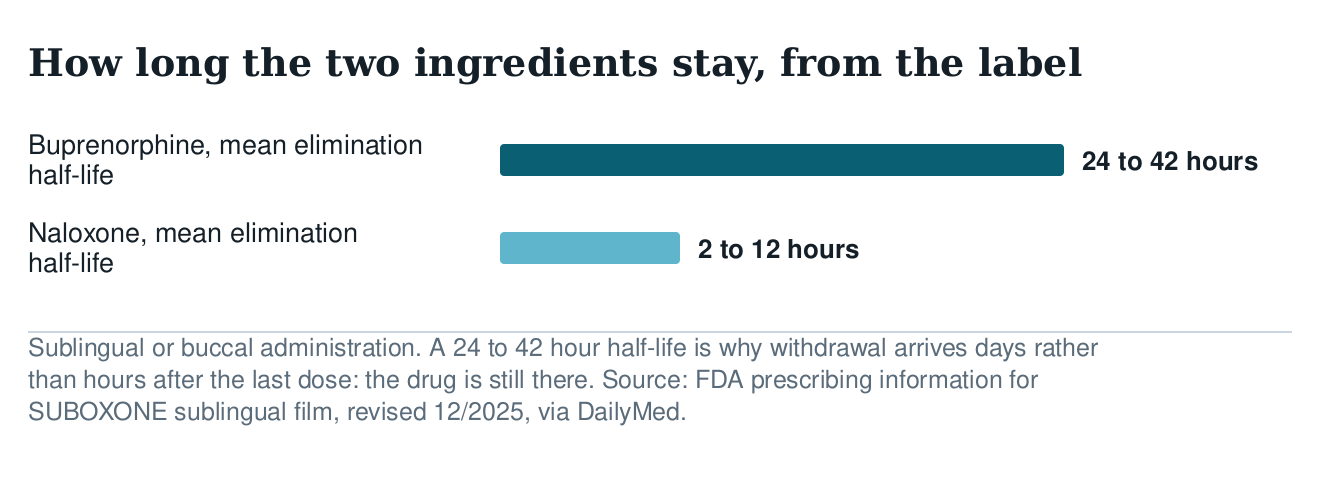
Buprenorphine leaves the body slowly: the FDA label gives a mean elimination half-life of 24 to 42 hours, against a few hours for most opioids people switch from. That single number explains the two things that surprise people. Withdrawal starts late rather than the next morning, and the label states it plainly, that the syndrome is typically milder than with full agonists but may be delayed in onset. The label also says to taper rather than stop, and that is where the practical problem sits: we counted the federal directory and 51.6 per cent of US facilities offer buprenorphine maintenance while only 34 per cent offer a medically supervised withdrawal from it.
The short version
- Half-life 24 to 42 hours — from the FDA label. Withdrawal is delayed because the drug is still there, not because nothing is happening
- Milder but longer — the label says the syndrome is typically milder than with full agonists and may be delayed in onset. Milder is not the same as shorter
- The label says taper, not stop — and it also says to warn patients about relapse to illicit drug use after discontinuation, which is the real risk here
- The on-ramp is wider than the off-ramp — we counted 9,152 facilities: 51.6% offer maintenance, 34.0% offer supervised withdrawal from it
- Buprenorphine is not for alcohol, benzodiazepine or gabapentin withdrawal — those are different mechanisms, and two of them are the withdrawals that can actually kill you
Where you can actually come off, counted
Our analysisThe label says to taper and leaves open who will help. The federal directory distinguishes buprenorphine maintenance from medically supervised withdrawal after stabilisation, so we pulled it and counted both. The gap between them is the practical answer to "where do I go to stop".
- 51.6%
- offer buprenorphine maintenance
- 4,726 of 9,152 facilities in our pull of the federal directory on 26 September 2026
- 34.0%
- offer medically supervised withdrawal after stabilisation
- 3,110 facilities. The on-ramp is roughly 1,600 facilities wider than the off-ramp
- 43.7%
- offer lofexidine or clonidine detoxification
- the non-opioid medicines aimed at symptoms, available more widely than supervised withdrawal itself
- 15.5%
- offer buprenorphine detoxification
- a short course rather than maintenance, which is a different service again
- 43.1%
- offer relapse prevention with naltrexone
- the option some people move to after finishing a taper
- 63.4%
- accept clients whose medication is prescribed elsewhere
- relevant when the prescriber and the counselling are not in the same place
How we got this: we pulled the full public listing from SAMHSA’s FindTreatment.gov on , removed duplicate entries by name, street and ZIP, and counted how many of the 10,233 remaining facilities report each service. SAMHSA publishes the directory; it does not publish these proportions — see how the count is made. Repeat the pull and you will get the same numbers, give or take facilities that opened or closed since.
What these numbers cannot tell you: they are self-reported by facilities, they describe availability rather than quality, and a national proportion says nothing about what is open near you this week. Use them to know what to ask for, not to decide where to go.
Why this withdrawal arrives late
Most withdrawal timelines are really half-life tables in disguise. For Suboxone the number is unusually long: the FDA label gives buprenorphine a mean elimination half-life of 24 to 42 hours when the film is taken under the tongue or inside the cheek, and naloxone 2 to 12 hours. Compare that with heroin, oxycodone or hydrocodone, where the drug is largely gone within hours, and the shape of the thing becomes obvious. Buprenorphine is still occupying receptors on day two. The body has not yet noticed it is missing.
What the label says in its own words
Section 5.7 of the label is the sentence worth memorising: buprenorphine is a partial agonist at the mu-opioid receptor, chronic administration produces physical dependence of the opioid type, characterised by withdrawal signs and symptoms upon abrupt discontinuation or rapid taper, and the withdrawal syndrome is typically milder than seen with full agonists and may be delayed in onset. Two claims, both useful. Milder, which is a relief. Delayed, which is the part that catches people out.
Why milder does not mean shorter
People read milder and plan for a short unpleasant week. The mechanism points the other way. A drug that clears slowly produces a gentler but longer decline, and a partial agonist comes off a receptor it was only partly activating. The intensity is lower than full-agonist withdrawal at its peak and the tail is longer. Someone who has budgeted three days off work on the strength of a heroin-withdrawal timeline has mismatched the plan to the drug.
The interaction almost nobody warns about
The label notes something worth knowing if you take other medicines. Certain drugs inhibit the CYP3A4 enzyme that breaks buprenorphine down. When such a drug is stopped, buprenorphine concentration falls, and the label states this can produce a withdrawal syndrome in someone who had developed physical dependence. Withdrawal appearing without any change to the Suboxone dose is not imagination, and the first thing to check is what else changed.
When does it actually start
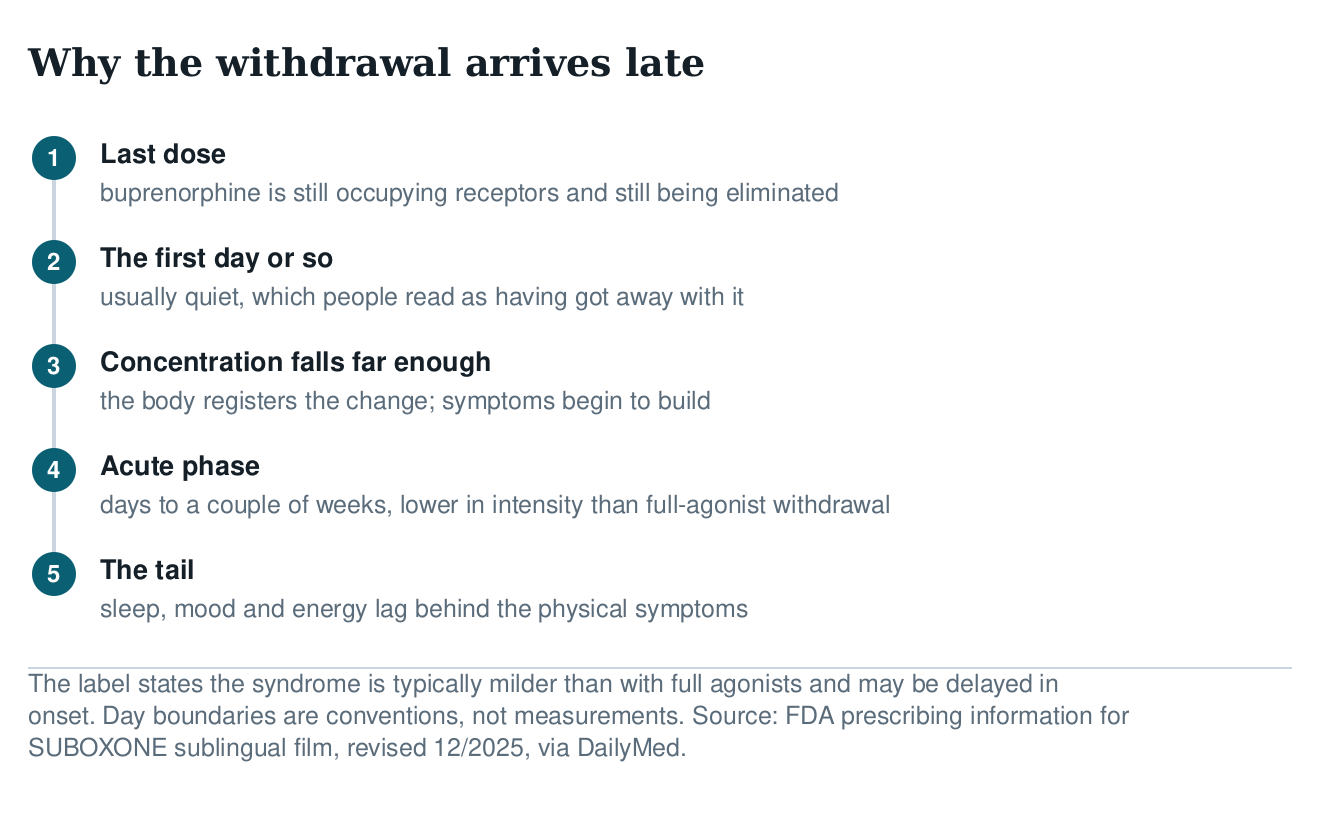
This is the question behind the most-searched phrasings, and it is a different question from how long it lasts. Because of the half-life, symptoms generally do not appear on the first missed day. Expect the onset to be measured in days rather than hours, with the first clear signs commonly appearing once the drug has fallen far enough, which for a 24 to 42 hour half-life takes longer than one night. The label does not print an hour count for onset, and neither will we.
Why a precise onset figure is not available
The half-life itself is a range, and it sits on top of dose, how long you were on it, liver function, which other medicines you take, and body composition. The label notes that plasma levels run higher and half-life longer in moderate and severe hepatic impairment. Any page giving you a confident hour is averaging over people who are not you. What is reliable is the direction: later than you expect, and later than the withdrawal you may have been through before.
I took my dose and still feel withdrawal
A common and confusing experience with several explanations worth separating. It can be the tail of a previous opioid still clearing. It can be precipitated withdrawal, if the dose was taken too soon after a full agonist. It can be an interaction as described above. And it can be that the dose is genuinely too low for you, which is a prescriber conversation rather than a timeline question. The one thing it is unlikely to be is the medicine simply not working.
The timeline, and why every published version disagrees
Here is the sequence as clinical sources describe it, with the honest caveat that the day boundaries circulating online are conventions rather than measurements. The first days after the last dose are usually quiet, because the drug is still present. Symptoms build over the following several days as concentration falls, and the acute phase then runs for a stretch of days to a couple of weeks. After the acute phase, sleep, mood and energy commonly lag behind, and that tail can extend for weeks or longer after long-term use. A taper changes the shape entirely, which is the point of one.
What varies, and by how much
Dose at the point of stopping, how long you were taking it, whether you tapered or stopped, other substances in the picture, and any psychiatric condition underneath. Those five between them account for most of the spread, and they are also why two honest people can describe completely different experiences of the same drug without either one being wrong.
Why forum accounts read worse than clinical ones
Search results for this fill up with Reddit threads, and that is worth reading with the selection effect in mind. People who taper slowly under supervision and find it manageable have little reason to write about it. People who stopped abruptly, or ran out, or were tapered faster than they could handle, have every reason. Both accounts are real. Read them as a description of the hard end of the range rather than as the expected case, and note whether the person tapered.
What it actually feels like
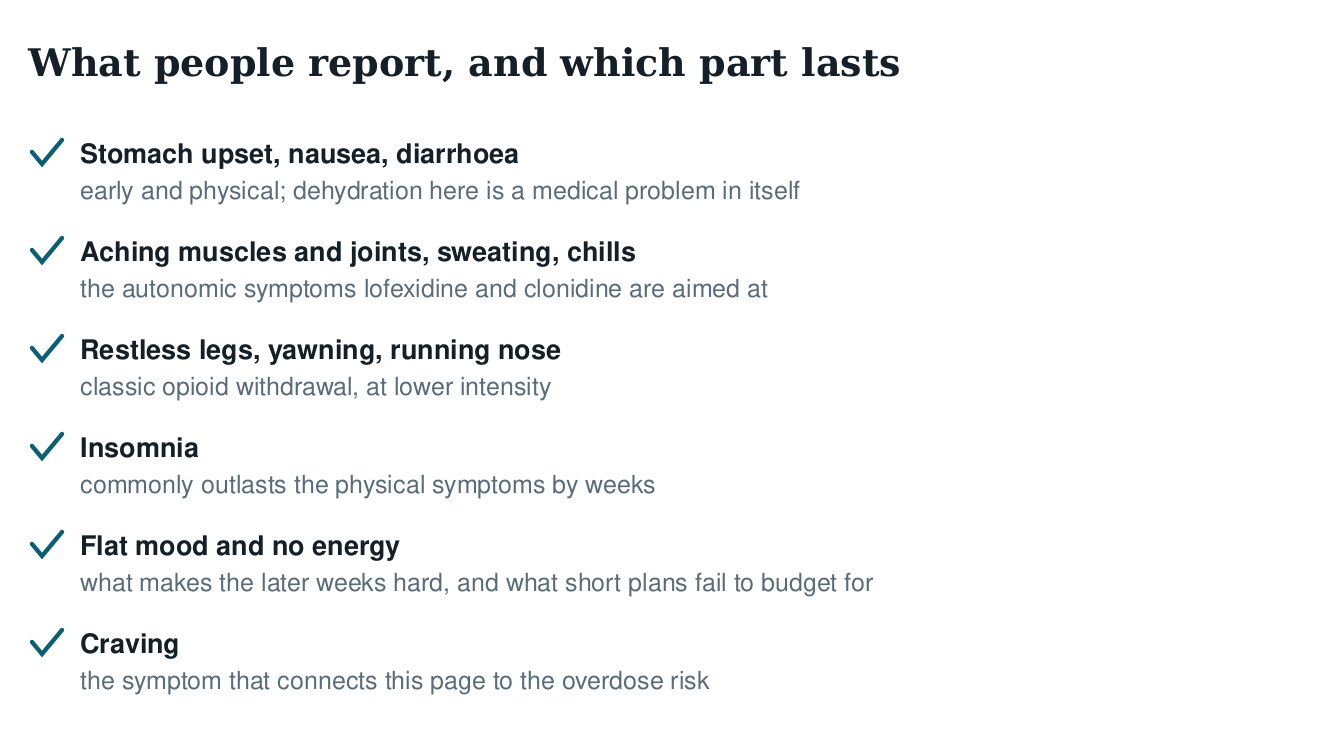
Opioid withdrawal symptoms are well described and buprenorphine withdrawal follows the same pattern at lower intensity: stomach upset and diarrhoea, nausea, aching muscles and joints, sweating and chills, a running nose and yawning, restless legs, and dilated pupils. The parts people find hardest are usually not those. Insomnia that lasts past the physical symptoms, flattened mood, and an absence of energy are what make the later weeks difficult, and they are the ones a short plan fails to account for.
How bad does it get
The label gives the honest comparative answer rather than a severity score: typically milder than withdrawal from full agonists. That is a real difference and worth holding on to. It does not mean comfortable, and it does not mean brief. Severity tracks dose and speed more than anything else, which is why the one variable genuinely in your control is how fast you come down.
Can you die from it
Opioid withdrawal on its own is not generally considered life-threatening in the way that untreated alcohol or benzodiazepine withdrawal can be. The dangers around it are different and real: dehydration from persistent vomiting and diarrhoea, which is a medical problem in its own right; a serious drop in mood; and above all the overdose risk that comes with returning to use after tolerance has fallen. If someone cannot keep fluids down, that is a reason to get medical help rather than to push through.
Coming off: what the label actually instructs
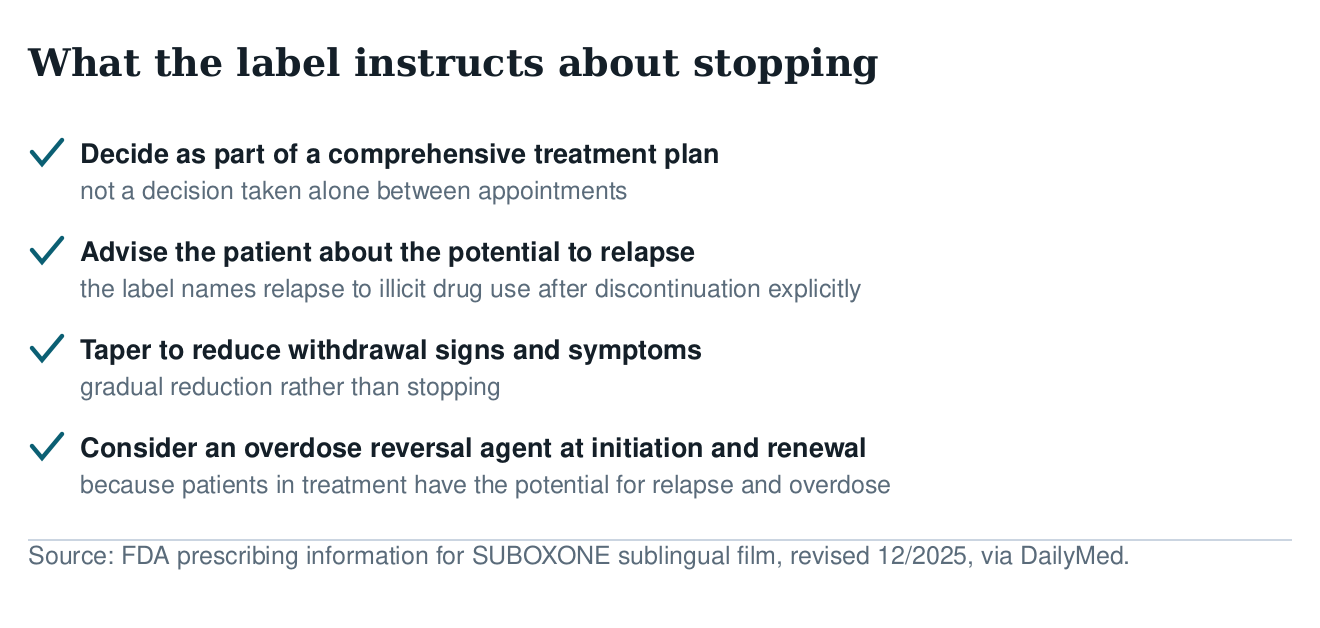
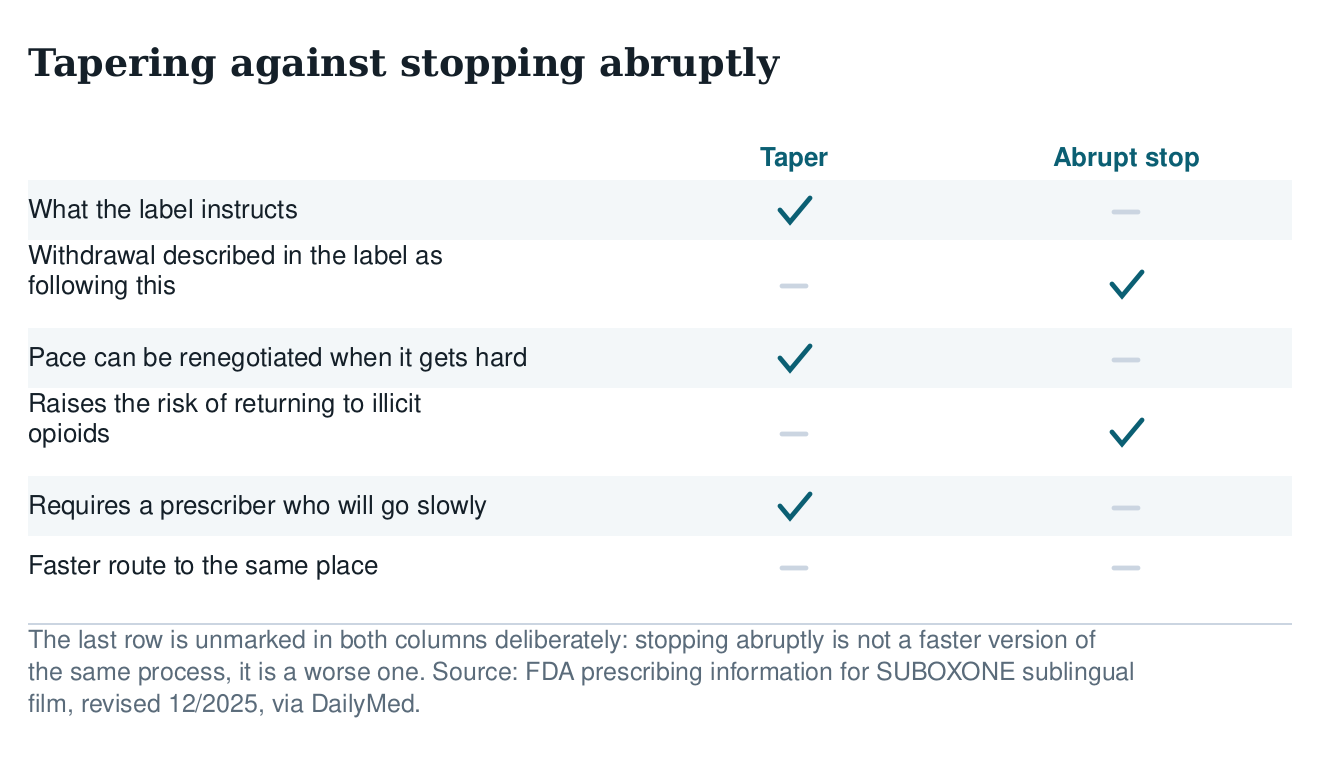
Section 2.8 of the label covers discontinuing treatment and it is short enough to quote in substance. The decision to stop after a period of maintenance should be made as part of a comprehensive treatment plan. Patients should be advised of the potential to relapse to illicit drug use following discontinuation. And patients should be tapered to reduce the occurrence of opioid withdrawal signs and symptoms. Three instructions, and the middle one is the one that gets left out of most articles on this subject.
Stopping abruptly is the thing the label warns against
The withdrawal described in section 5.7 is specifically what follows abrupt discontinuation or rapid taper. Quitting cold turkey is not a faster route to the same destination, it is a different and worse experience of the same process, and it raises the risk of the outcome the label names, which is returning to illicit opioids. If the reason for stopping abruptly is that the prescription ran out or an appointment was missed, that is a supply problem with a supply solution.
Tapering at home
Plenty of people do taper at home, and the label does not require inpatient care to do it. What it does require is that the decision sits inside a treatment plan, which means a prescriber who knows your history, adjusts the pace when it stops being tolerable, and can slow down without it counting as failure. The things worth arranging before starting are unglamorous: a pace you can renegotiate, someone who knows what you are doing, naloxone in the house, and an agreement with yourself about what happens if it goes badly.
Where you can actually taper, counted
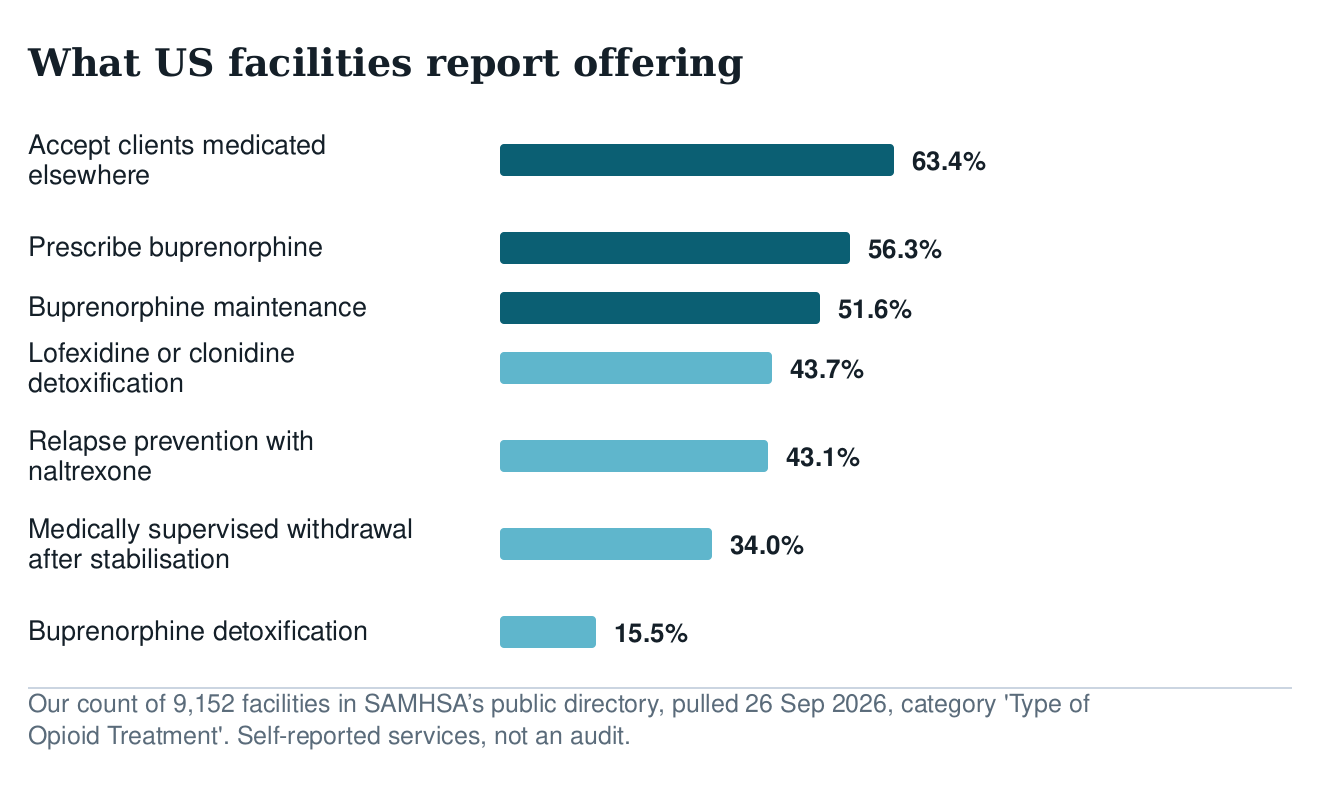
The label says to taper. It does not say who will help you. We pulled the federal treatment directory and counted, because the distinction the directory draws is exactly the one that matters here: it records buprenorphine maintenance and a separate service described as maintenance with medically supervised withdrawal after stabilisation. Those are different offerings, and the gap between them is the practical shape of this problem.
| What the directory records | Share of facilities | Facilities |
|---|---|---|
| Accepts clients whose medication is prescribed elsewhere | 63.4% | 5,804 |
| Prescribes buprenorphine | 56.3% | 5,152 |
| Buprenorphine maintenance | 51.6% | 4,726 |
| Lofexidine or clonidine detoxification | 43.7% | 3,998 |
| Relapse prevention with naltrexone | 43.1% | 3,947 |
| Medically supervised withdrawal after stabilisation | 34.0% | 3,110 |
| Buprenorphine detoxification, a short course | 15.5% | 1,421 |
Accepts clients whose medication is prescribed elsewhere
- Share of facilities
- 63.4%
- Facilities
- 5,804
Prescribes buprenorphine
- Share of facilities
- 56.3%
- Facilities
- 5,152
Buprenorphine maintenance
- Share of facilities
- 51.6%
- Facilities
- 4,726
Lofexidine or clonidine detoxification
- Share of facilities
- 43.7%
- Facilities
- 3,998
Relapse prevention with naltrexone
- Share of facilities
- 43.1%
- Facilities
- 3,947
Medically supervised withdrawal after stabilisation
- Share of facilities
- 34.0%
- Facilities
- 3,110
Buprenorphine detoxification, a short course
- Share of facilities
- 15.5%
- Facilities
- 1,421
Half will start you, a third will help you stop
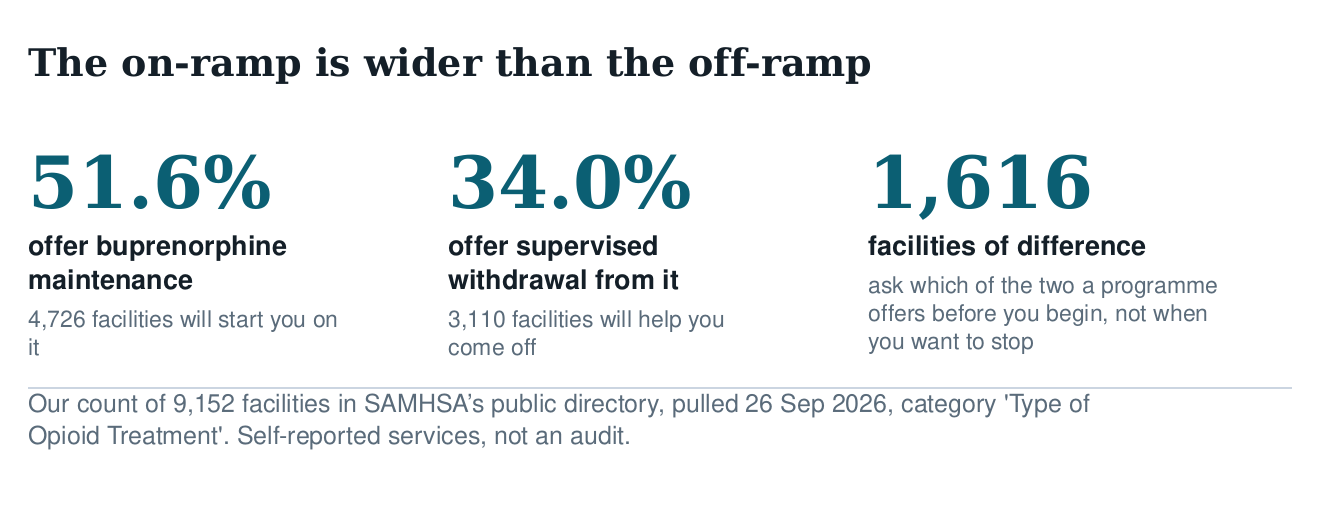
Across 9,152 facilities, 51.6 per cent report buprenorphine maintenance and 34.0 per cent report medically supervised withdrawal after stabilisation. That is a gap of roughly 1,600 facilities. Somebody started on buprenorphine at a programme without the second service tends to discover this only when they decide to come off, often months or years later, and the discovery frequently arrives at the same moment as the decision. Asking at the start costs nothing.
What else the directory shows
Buprenorphine detoxification, meaning a short course rather than maintenance, is reported by 15.5 per cent. Lofexidine or clonidine detoxification, the non-opioid medicines aimed at symptoms, by 43.7 per cent, which is wider than supervised withdrawal itself. Relapse prevention with naltrexone, the option some people move to after coming off, by 43.1 per cent. And 63.4 per cent accept clients whose medication is prescribed elsewhere, which matters if your prescriber and your counselling are in different places.
What these numbers are not
Self-reported service categories, not an audit. A facility ticking supervised withdrawal has told the directory it offers that; it has not demonstrated how slowly it is willing to go, which is the thing you actually care about. Use the figure to understand the landscape and the phone call to check the specific place. The useful question is not whether they taper but how slowly they will, and what happens if you need to pause.
Why we will not print a taper chart
Two of the most searched phrases attached to this subject ask for a dose schedule and a taper chart. We are not going to publish one, and the reason is worth stating rather than quietly omitting. A schedule that looks authoritative invites someone to follow it instead of their prescriber, and the correct pace depends on the starting dose, how long you have been on it, what else you take, how previous attempts went, and what is happening in your life during the taper. None of that is knowable from a web page.
What to discuss instead
Bring the questions rather than a plan. How slowly are you willing to go, and what is the smallest reduction you can prescribe. What happens if a step is too hard, and can we hold at a dose rather than going back up. What do we do about sleep, which is the symptom that outlasts the rest. Is there a role for a non-opioid medicine during the steps. And what is the plan after the last dose, since that is when the overdose risk peaks.
Medicines aimed at the symptoms
Coming off buprenorphine is not only a matter of dose reduction. Non-opioid medicines exist for the symptoms themselves, and the federal directory records them as a distinct service: 43.7 per cent of facilities report lofexidine or clonidine detoxification. Both are used to blunt the autonomic side of opioid withdrawal, the sweating, cramping and restlessness, without being opioids themselves. They do not remove withdrawal and they are not a substitute for a sensible pace, but they are a real option and many people are never told they exist.
The things people reach for that are not that
Gabapentin comes up constantly in searches around this topic, in both directions, and it is worth being precise. It is prescribed off-label by some clinicians for withdrawal symptoms, it is not a treatment for opioid dependence, and it carries its own dependence and withdrawal profile. Using it privately to get through a taper swaps one problem for another. That is a conversation for the prescriber managing the taper, not a purchase.
Does Suboxone help with kratom or 7-OH withdrawal
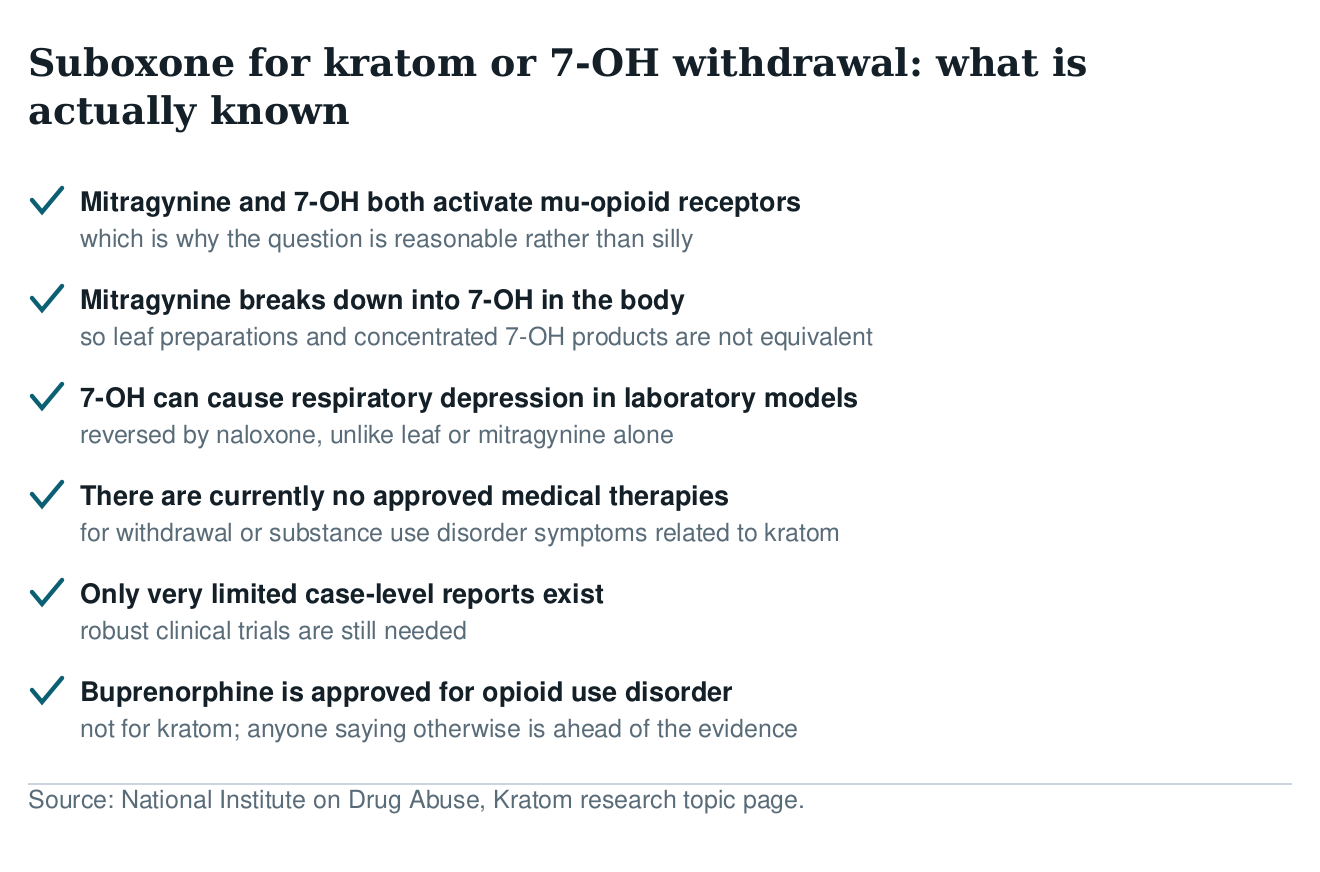
This question generates more search volume than most people working in the field would guess, and it deserves a direct answer rather than a sales page. The pharmacology makes the question reasonable. The federal research institute describes kratom leaves as containing mitragynine and 7-hydroxymitragynine, known as 7-OH, notes that mitragynine breaks down into 7-OH in the body, and states that both activate mu-opioid receptors, though the effects only partially compare with opioids such as heroin or oxycodone. The compound is written both ways, 7-OH and 7OH, and the products sold as concentrated 7OH extracts are a recent development rather than the traditional leaf.
What the evidence actually supports
Here is the honest position, and it is not what a treatment advertisement will tell you. The federal source states that withdrawal and substance use disorder symptoms related to kratom have not been extensively studied, that there are currently no approved medical therapies for these conditions, and that in very limited cases researchers have reported using medications and other therapies, with robust clinical trials still needed. Buprenorphine is approved for opioid use disorder. It is not approved for kratom, and anybody telling you otherwise is ahead of the evidence.
Other buprenorphine products behave differently
Worth separating, because people search for these as if they were one thing. The transdermal patch sold as Butrans delivers buprenorphine continuously at doses aimed at pain rather than opioid use disorder, and its withdrawal profile follows that lower exposure. Sublocade is a monthly injection, so its concentration declines over weeks after the last dose rather than days, which stretches the same delayed onset further still. Subutex is buprenorphine without naloxone. All share the long half-life that makes withdrawal late, and none of them changes the instruction in the label to taper rather than stop.
Why a partial agonist may not hold
People report that it does not always work for this, and the pharmacology offers a plausible reason. Buprenorphine is a partial agonist with very high receptor affinity, so it both occupies receptors and limits how much they can be activated. Against a different alkaloid profile, and with dosing worked out for a different drug, the fit is not guaranteed. This is exactly the situation where a clinician experienced with both matters more than a protocol, and where the answer is genuinely uncertain rather than withheld.
The 7-OH detail worth carrying
One finding from the same source has practical weight. Neither kratom leaves nor mitragynine generally appear to produce the respiratory depression characteristic of a life-threatening opioid overdose, but in laboratory models 7-OH can cause respiratory depression that is reversed by naloxone. Products concentrated in 7-OH are therefore not equivalent to traditional leaf preparations, and naloxone is relevant. For legal status: the DEA lists kratom as a drug of concern, it is not on the US controlled substances schedule, and the WHO expert committee concluded in 2021 that evidence did not warrant international control while keeping it under surveillance.
What buprenorphine is not for
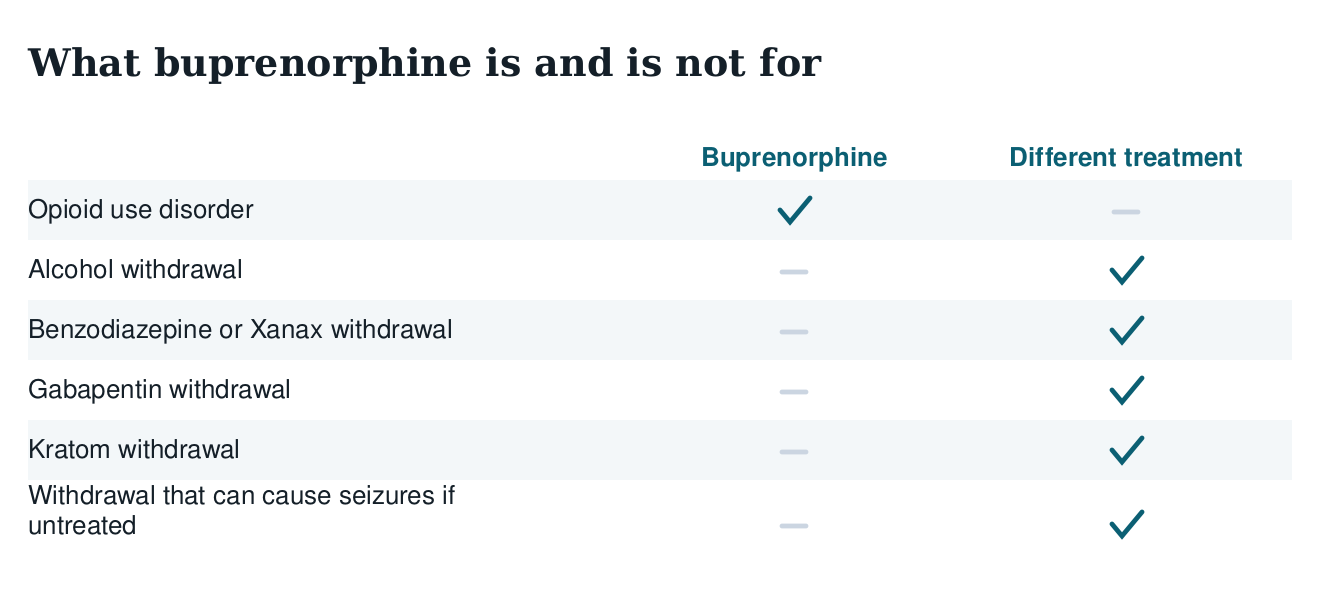
A cluster of searches asks whether Suboxone helps with alcohol, benzodiazepine, Xanax or gabapentin withdrawal. The answer is no, and this one is not a matter of insufficient evidence but of mechanism. Buprenorphine acts at opioid receptors. Alcohol and benzodiazepine withdrawal are driven by different systems entirely, and the treatments for them are different drugs.
Why this particular mistake is dangerous
Because these are the withdrawals that can kill. Untreated alcohol withdrawal and untreated benzodiazepine withdrawal can produce seizures and delirium, which is not true of opioid withdrawal on its own. Somebody who reaches for buprenorphine to manage an alcohol or benzodiazepine problem is not merely using something ineffective, they are substituting it for care that has a genuine medical urgency. If that is the situation, the search to run is medical detox, not this page.
Precipitated withdrawal: when the medicine causes it
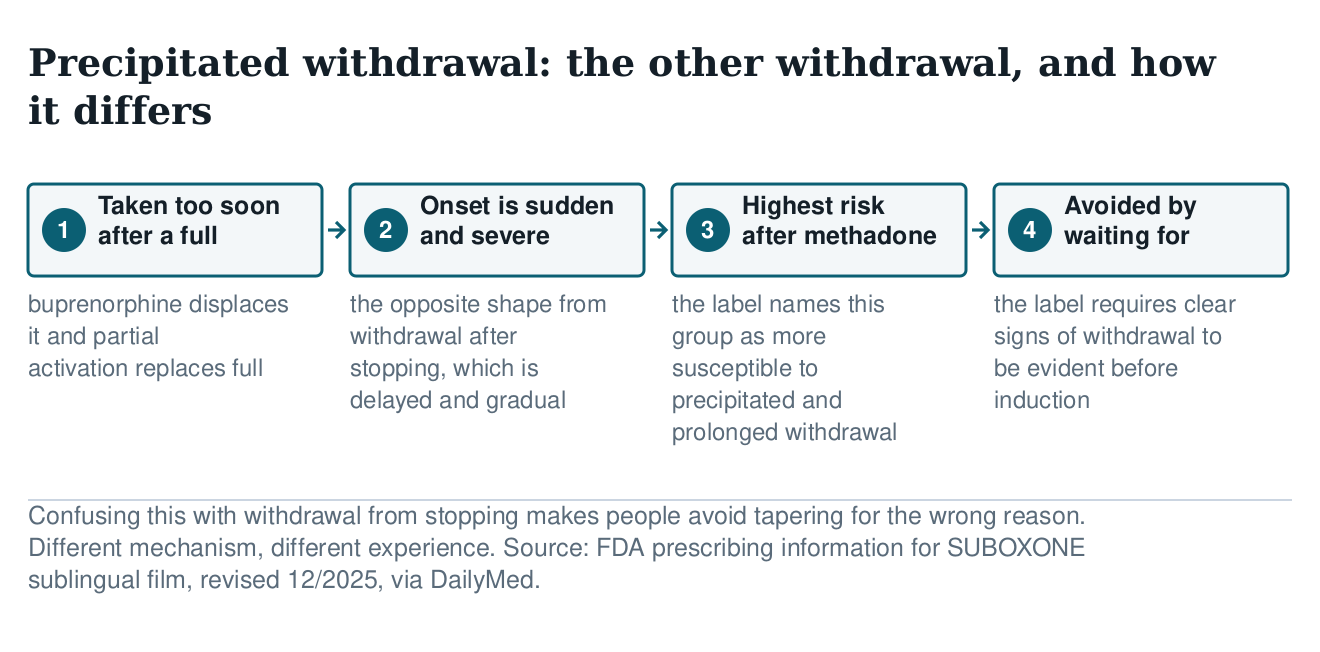
The other withdrawal associated with Suboxone is the one it can trigger on the way in, and it belongs on this page because people who have experienced it often fear the taper for the wrong reason. The label instructs that to avoid precipitating withdrawal, induction should be undertaken when objective and clear signs of withdrawal are evident, in divided doses, and that the sublingual route rather than buccal should be used during induction to minimise naloxone exposure.
Who is most at risk of it
The label is specific: patients dependent on methadone or long-acting opioid products may be more susceptible to precipitated and prolonged withdrawal during induction than those dependent on short-acting opioids, and it notes that buprenorphine with naloxone products have not been evaluated in adequate and well-controlled studies for induction in patients physically dependent on long-acting opioids. That is a real caution and a reason for the induction to be supervised.
It is not the same event as coming off
Precipitated withdrawal is sudden, severe, and caused by taking the medicine too soon after a full agonist. Withdrawal from stopping buprenorphine is delayed, milder and gradual. Confusing the two leads people to expect the taper to feel like the induction did, and to avoid tapering because of it. Different mechanism, different experience.
The risk that actually matters here
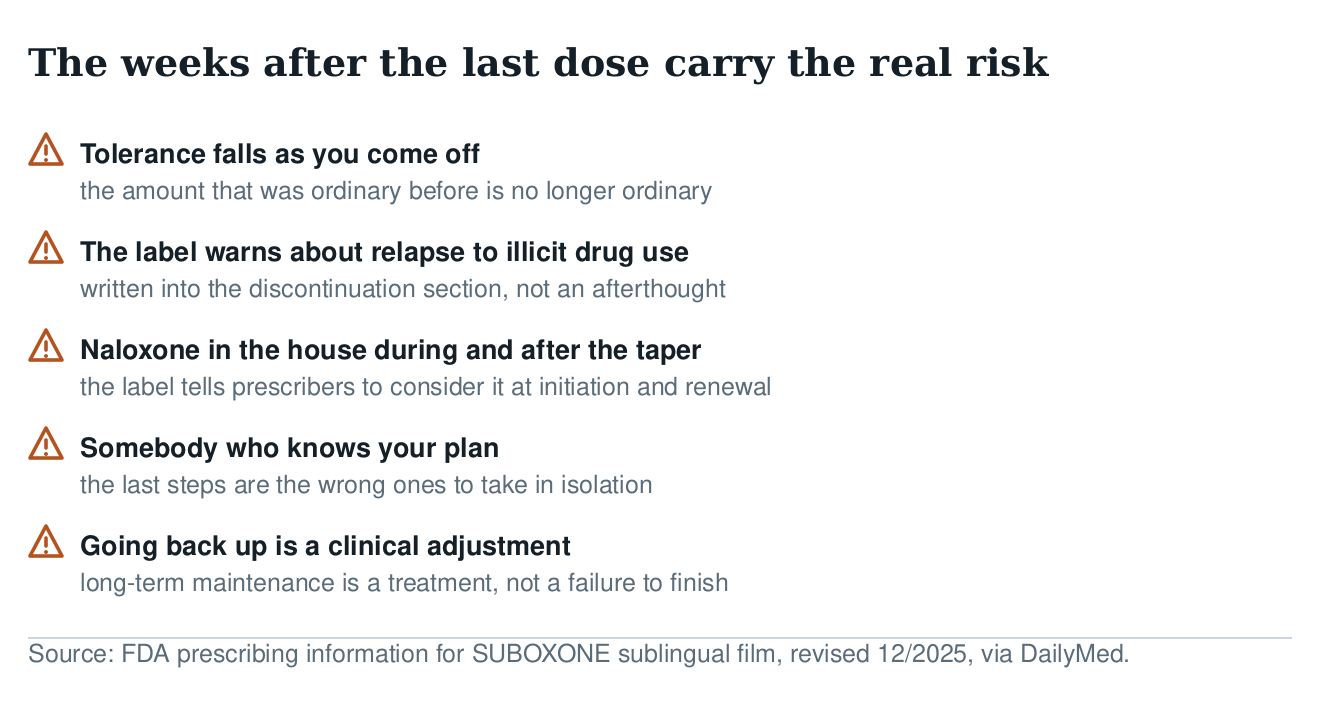
Everything above is about comfort. This part is about survival, and the label puts it in two separate places. Section 2.8 says to advise patients of the potential to relapse to illicit drug use following discontinuation. Section 2.2 says to strongly consider recommending or prescribing an opioid overdose reversal agent when Suboxone is initiated or renewed, because patients being treated for opioid use disorder have the potential for relapse, putting them at risk of overdose.
Why the weeks after the last dose are the dangerous ones
Tolerance falls while you come off. If a return to use happens after that, the amount that was ordinary before is no longer ordinary, and in a supply now widely contaminated with fentanyl the margin is thinner still. This is not an argument against ever coming off. It is an argument for naloxone being in the house during and after the taper, for somebody knowing your plan, and for not doing the last steps in isolation.
Staying on is a legitimate outcome
Worth saying plainly, because a page about withdrawal implicitly frames stopping as the goal. Long-term maintenance is an evidence-based treatment, not a failure to finish. The label frames discontinuation as a decision made within a treatment plan rather than a milestone to reach. If the taper turns out to be the wrong move this year, going back up is a clinical adjustment.
This is a different question from how long Suboxone stays in your system
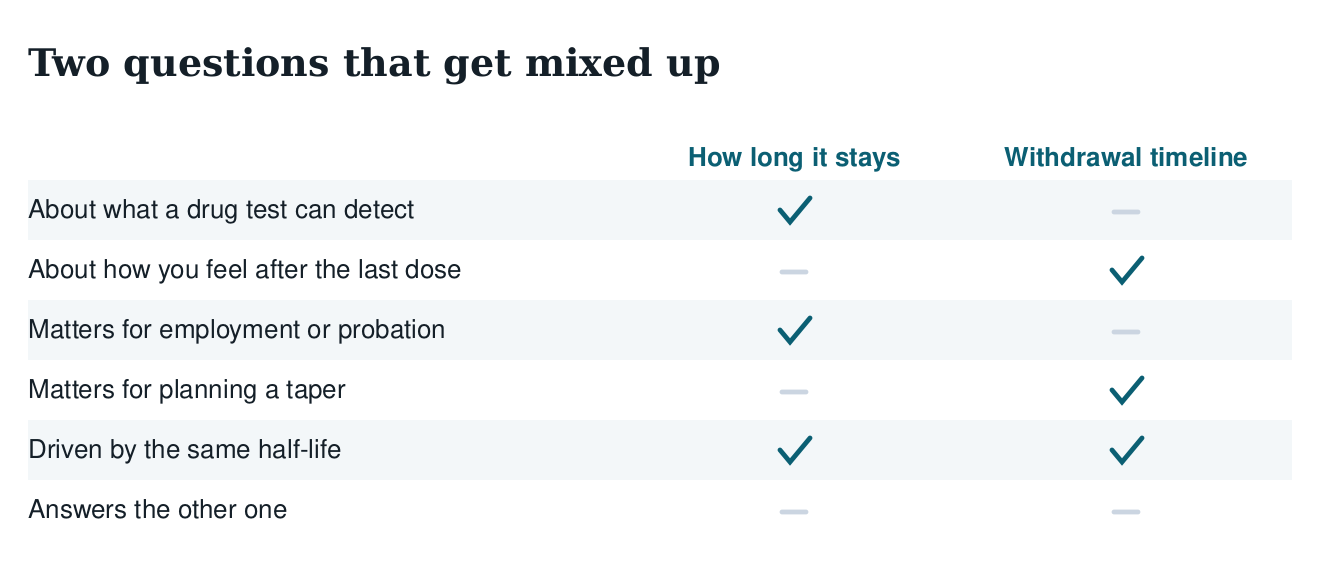
Two questions get mixed constantly and they have different answers and different uses. How long the drug stays in your system is pharmacokinetics: what a test can detect and for how long, which matters for employment, probation and clinical monitoring. How long withdrawal lasts is about symptoms after the drug falls below the level your body has adapted to. The half-life connects them, which is why they get confused, but knowing the detection window tells you nothing useful about how the weeks after stopping will feel.
Which page you want
If the question is a drug test, a detection window or how long the medicine is measurable, our page on how long Suboxone stays in your system covers that in detail and this one will not help. If the question is what happens to you after the last dose, you are in the right place.
What this page cannot tell you
It cannot tell you your onset or your duration, because both depend on a history we do not have, and the half-life itself is a range before any of your own variables are applied. It cannot give you a taper schedule, and the reason is above rather than hidden. It cannot tell you whether buprenorphine will work for a kratom or 7-OH problem, because the research that would answer that has not been done. What it can do is explain why the withdrawal behaves the way it does, show you what the label instructs, and tell you honestly how many places offer the help the label assumes you have.
Where this sits in the system of care
Addiction treatment is organised into levels of care, and clinicians choose between them using the ASAM criteria (six dimensions covering withdrawal risk, medical and psychiatric conditions, readiness, relapse risk and, decisively, the environment you return to. Facilities are licensed by the state and many hold additional accreditation from bodies such as the Joint Commission or CARF; that status is worth confirming for any specific programme. Percentages below are our count of how many facilities in the federal directory report offering each level of care.
- Detox19.5% of facilitiesmedical withdrawal management, 3–7 daysDetox vs rehab
- Residential21.4% of facilitieslive on site, 24-hour staffingInpatient vs outpatient
- PHP20–30 structured hours a week, sleep at homePHP vs IOP
- IOP9–19 hours a week, usually compatible with workPHP vs IOP
- Standard outpatient85.4% of facilities1–8 hours a week, the maintenance levelMutual aid options
“Remaining in treatment for an adequate period of time is critical.”
Programmes for specific groups
Facilities also report dedicated programming, and the coverage is wider than most people expect, worth asking about before assuming a programme will not fit. From our count: 42.7% run programmes for adolescents, 39.2% for veterans, 38% for pregnant and postpartum women, and 25% provide services in Spanish. Medication for opioid use disorder is available at 59.2% (buprenorphine) and 13.7% (methadone).
Cost and coverage vary by level: residential care is the tier insurers scrutinise most and almost always requires prior authorisation before admission. See what your plan covers and how to pay without insurance. Family involvement is a standard part of most programmes, and aftercare planning ( step-down to a lower level, sober living, relapse prevention) should be discussed before admission, not at discharge. If a mental health condition is also present, ask specifically whether the programme is staffed for co-occurring disorders: 69.5% of facilities in the directory report treating them, but that is a self-reported field worth confirming.


Common questions
How long does Suboxone withdrawal last?
Longer than withdrawal from short-acting opioids, because buprenorphine has a mean elimination half-life of 24 to 42 hours according to the FDA label. The acute phase generally runs for days to a couple of weeks after the drug falls far enough, with sleep, mood and energy lagging behind for longer. A taper changes the shape substantially, which is the point of one.
How long after stopping does Suboxone withdrawal start?
Later than people expect. The label states the withdrawal syndrome may be delayed in onset, and with a 24 to 42 hour half-life the drug is still present on the second day. We do not publish an hour figure because the half-life is a range before your dose, duration of use and liver function are applied to it.
Is Suboxone withdrawal worse than heroin withdrawal?
The FDA label says the syndrome is typically milder than that seen with full agonists. It also says it may be delayed in onset. Lower intensity and a longer tail is the usual description, which is why people who plan for a short hard week find the timing wrong rather than the severity.
Can you die from Suboxone withdrawal?
Opioid withdrawal on its own is not generally considered life-threatening in the way untreated alcohol or benzodiazepine withdrawal can be. The genuine dangers around it are dehydration from persistent vomiting and diarrhoea, severe low mood, and the overdose risk that follows a return to use once tolerance has dropped.
Should I quit Suboxone cold turkey?
The label specifically describes withdrawal as following abrupt discontinuation or rapid taper, and instructs prescribers to taper patients to reduce it. It also instructs them to warn patients about the potential to relapse to illicit drug use after discontinuation. Stopping abruptly is a worse version of the same process, not a faster one.
Where can I get help tapering off Suboxone?
Fewer places than will start you on it. In our count of 9,152 facilities in the federal directory, 51.6% report buprenorphine maintenance and 34.0% report medically supervised withdrawal after stabilisation. Ask which of the two a programme offers before you begin, not when you want to stop.
Does Suboxone help with kratom or 7-OH withdrawal?
The pharmacology makes the question reasonable, since mitragynine and 7-hydroxymitragynine both activate mu-opioid receptors. But the federal research institute states there are currently no approved medical therapies for kratom withdrawal, with only very limited case-level reports and robust trials still needed. Buprenorphine is approved for opioid use disorder, not for kratom.
Does Suboxone help with alcohol, Xanax or gabapentin withdrawal?
No. Buprenorphine acts at opioid receptors, and alcohol and benzodiazepine withdrawal are driven by different systems. This matters more than most substitutions because untreated alcohol and benzodiazepine withdrawal can cause seizures, which opioid withdrawal on its own does not.
What medication helps with Suboxone withdrawal symptoms?
Non-opioid medicines aimed at the symptoms exist, and the federal directory records lofexidine or clonidine detoxification as a distinct service offered by 43.7% of facilities. They blunt the autonomic symptoms rather than removing withdrawal, and they are prescribed rather than bought.
Why will you not give me a taper schedule?
Because the right pace depends on your starting dose, how long you have taken it, what else you take, how previous attempts went, and what is happening in your life during the taper. A chart that looks authoritative invites people to follow it instead of a prescriber who knows those things.
I took my dose and still feel withdrawal. Why?
Several possibilities worth separating: the tail of a previous opioid still clearing, precipitated withdrawal if the dose came too soon after a full agonist, a dose that is genuinely too low for you, or an interaction. The label notes that stopping a CYP3A4 inhibitor lowers buprenorphine levels and can produce withdrawal with no change to your dose.
Is it safe to stay on Suboxone long term instead?
Long-term maintenance is an evidence-based treatment rather than a failure to finish. The label frames stopping as a decision taken within a comprehensive treatment plan, not a milestone. If a taper turns out to be the wrong move this year, going back up is a clinical adjustment.
Sources
- FDA prescribing information for SUBOXONE sublingual film (Indivior), via DailyMed, revised 12/2025
- NIDA: Kratom, on mitragynine and 7-OH at mu-opioid receptors and the absence of approved therapies for kratom withdrawal
- SAMHSA FindTreatment.gov, the public directory we counted
- NIDA: Medications for Opioid Use Disorder
Compare levels of care
Check what your plan covers
How this page was made
- Who wrote it:
- the Treatment Compass editorial team : researchers and writers, not clinicians. No doctor has reviewed this page, and we do not claim otherwise. What that means in practice: we report what public clinical sources say and show you where to read them, rather than offering a clinical opinion of our own.
- Checked against:
- 4 primary sources listed above: federal agency material and published clinical criteria. Where a figure varies by state, plan or facility, we say so instead of publishing a number that looks authoritative and is not.
- Original analysis:
- the facility proportions on this page are our own count of SAMHSA’s public directory. The full method is documented , including what we count, what we deliberately do not publish, and an error the approach caught. You can repeat the pull and check the numbers.
- Last reviewed:
- . This date changes when the content is actually re-checked, not automatically on every visit.
- What this page is not:
- a medical recommendation, a diagnosis, or a referral. Decisions about levels of care and medication belong with a clinician who knows your history. We do not operate facilities, take placement fees, or receive payment for sending anyone anywhere.
Related on this site
- How long Suboxone stays in your systemthe other question: detection windows and pharmacokinetics, not symptoms after stopping
- Opioid withdrawal timelinethe faster, sharper withdrawal this one is usually compared against
- Suboxone vs methadonewhy induction and tapering differ between the two
- Naltrexone vs Suboxonethe option some people move to after completing a taper
More guides
- How to Get Someone Into RehabYou usually cannot force an adult into addiction treatment. What works is removing the obstacles, picking the moment, and knowing the legal exceptions.
- Paying for Rehab Without InsuranceState-funded programmes, sliding-scale fees, federal block grants and payment plans. What each option actually is, who qualifies, and how to reach it.
- Rehab Rules: What You Can and Cannot Do in TreatmentWhat treatment facilities restrict and why: phones, visitors, relationships, leaving early. Rules vary by level of care, so here is what to ask first.
- 7-OH Withdrawal Timeline: What It Is and Why Stopping Is HardWhat 7-hydroxymitragynine actually is, why withdrawal behaves like an opioid, and what the Federal Register says about the ban as of September 2026.
- Meth Withdrawal Timeline: What the Evidence Actually SaysWhere the 7-to-10-day figure comes from, why NIDA and the original study disagree, and our count of how few US facilities offer stimulant detox.
- Cocaine Withdrawal Timeline: What the Days Actually Look LikeThe crash, the weeks after, and why the withdrawal is not the dangerous part. With our own count of which treatments US facilities actually offer.
- Opioid Withdrawal Timeline: What Happens, and WhenSymptoms start around 12 hours after short-acting opioids and 30 after methadone. Fentanyl changes the picture, and the real danger comes after it ends.
- Relapse Warning Signs: What Comes Before Using AgainRelapse starts weeks before anyone picks anything up. The published model names three stages, and the early one has no thoughts of using in it at all.
- Rehab for Professionals: What Is Actually DifferentLicensed professionals get the best documented outcomes, and the most monitoring. What that trade involves, state by state.
- What Happens in Rehab: The Day, the Week, the MonthAdmission day is paperwork, not therapy. Most of the rest is group work. An honest account of the schedule, the therapies by name and the emotional arc.
- Court-Ordered Rehab: How It Works and What the Evidence ShowsA judge can order treatment by several routes, each with different consequences. Drug court, civil commitment and what each means.
- Sober Living Rules: What They Are and What Is EnforceableAbstinence, testing, curfew, chores and rent are near-universal. What is negotiable, what the law protects, how to spot a bad house.
- How Long Does Suboxone Stay in Your System?Buprenorphine has a 24 to 42 hour half-life. Urine tests find it for about a week, hair for months, and the blocking effect fades sooner than the drug does.
Weighing levels of care? See PHP vs IOP and what your insurance covers.
This page is information, not medical or legal advice. Laws on commitment and treatment differ by state. If you are in crisis, call or text 988 in the US, or reach the SAMHSA National Helpline at 1-800-662-4357 — free, confidential, 24/7.