Cocaine Withdrawal Timeline: What the Days Actually Look Like
Last updated
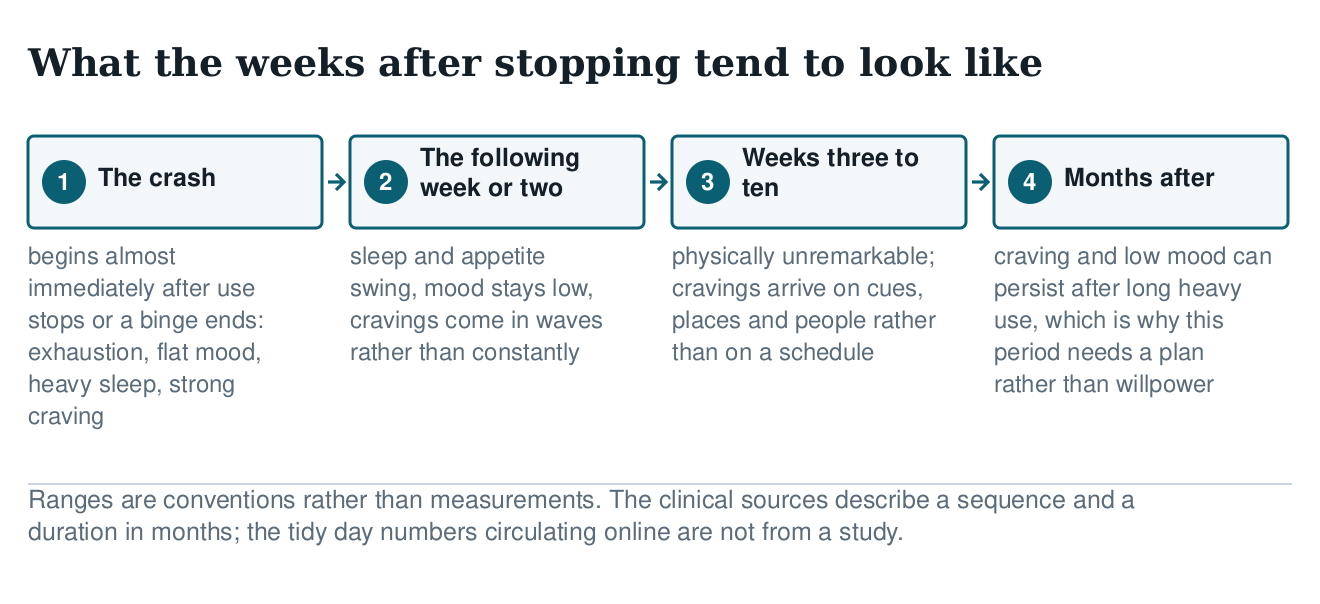
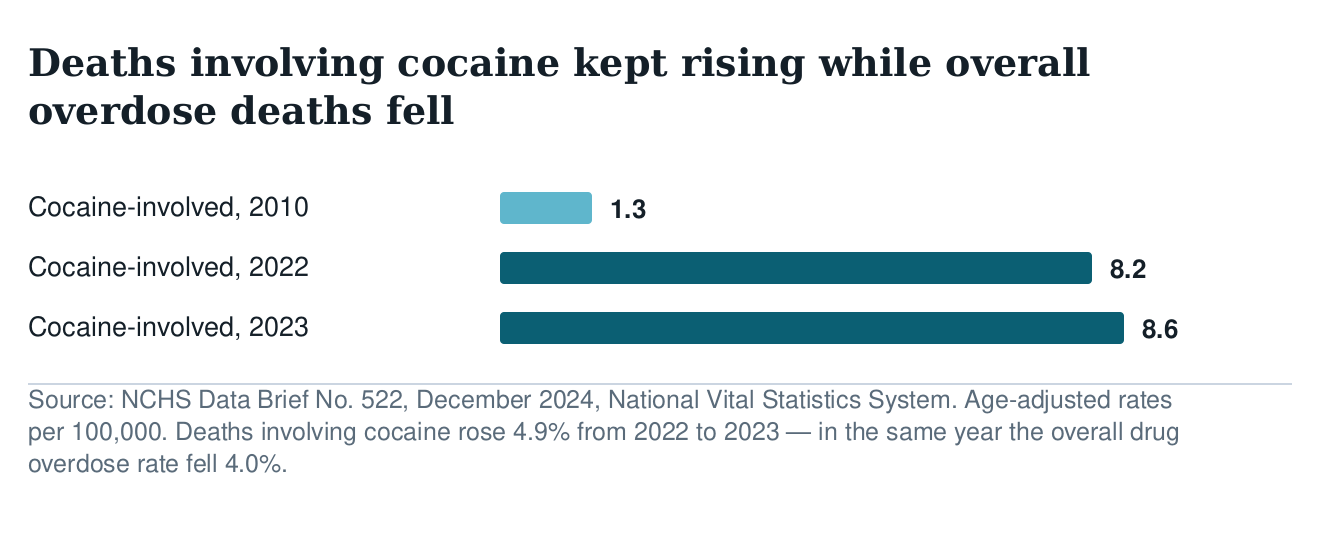
The crash starts almost as soon as use stops or a binge ends, and it is mostly psychological: exhaustion, flat mood, heavy sleep and a strong craving, without the vomiting and shaking that mark alcohol or opioid withdrawal. Craving and low mood can persist for months after long heavy use. The part worth planning for is not the withdrawal itself, which rarely needs medical care, but what comes after it. Deaths involving cocaine have risen every year since 2011 and rose again in 2023, in the same year overall overdose deaths fell, and the reason is fentanyl in the supply meeting a tolerance that a few clean days have already reset.
The short version
- The crash begins almost immediately — not after a delay, as with opioids: the clinical description is that it follows the end of use or a binge straight away
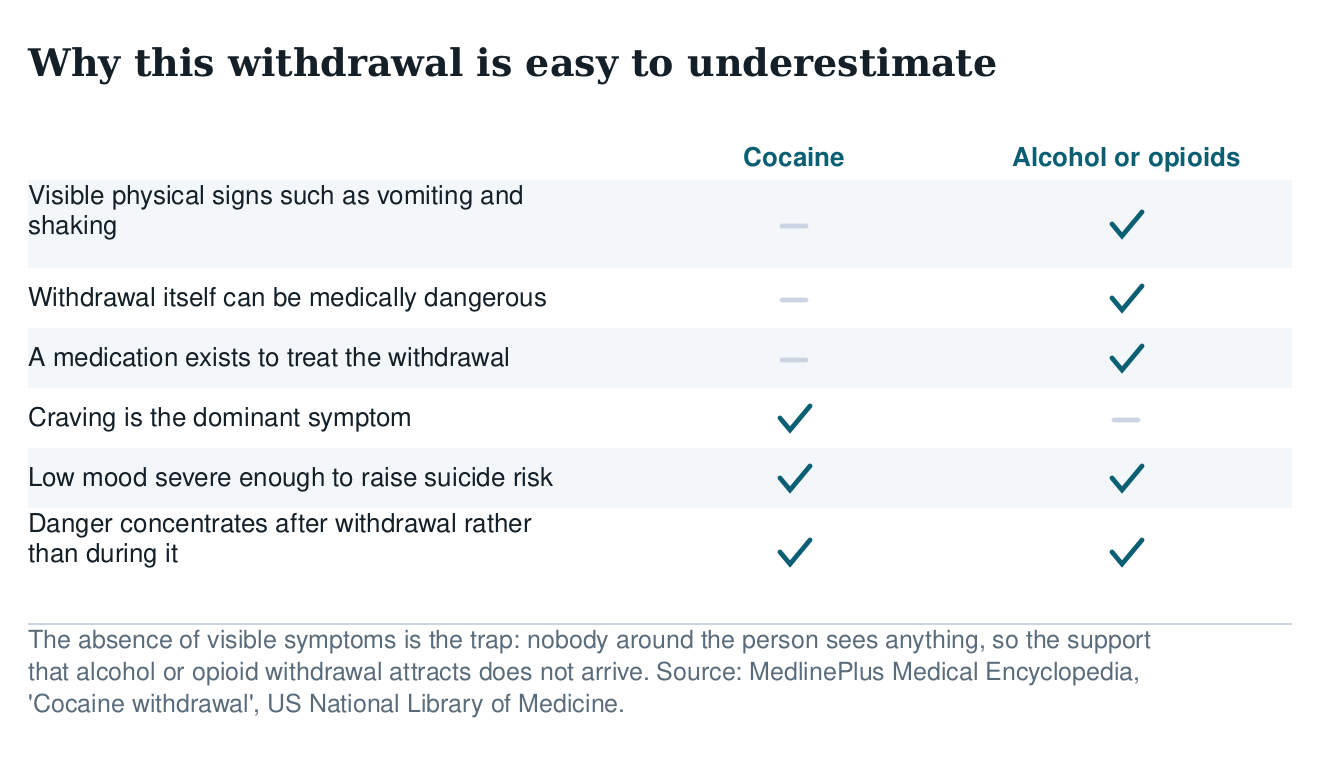
- There are no visible physical signs — which is why nobody around the person realises anything is happening, and why the support that alcohol withdrawal attracts does not arrive
- No medicine treats it — the National Library of Medicine states plainly that there are no medicines to reduce cocaine craving. The treatment is behavioural
- The danger sits after the withdrawal, not inside it — a few days without use resets opioid tolerance, and the next cocaine may contain fentanyl
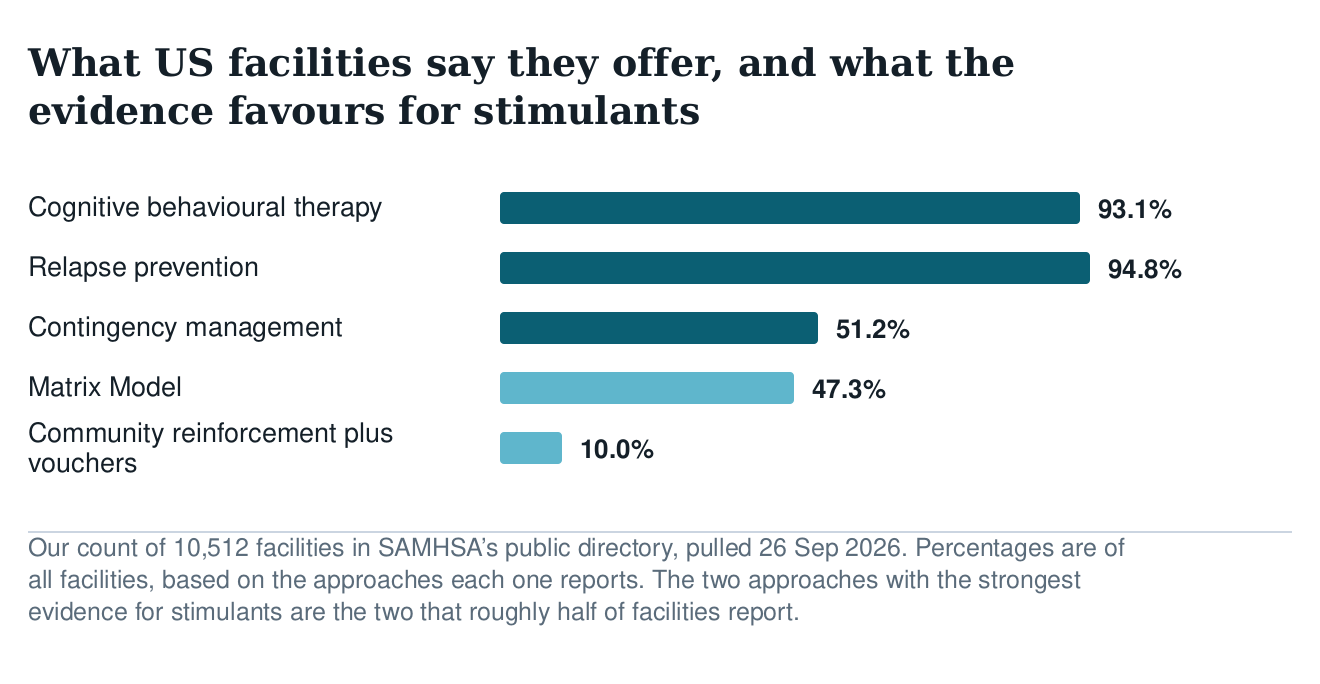
- Half of US facilities offer the treatment with the best evidence — we counted: 51.2% report contingency management, 47.3% the Matrix Model, across 10,512 facilities
Which treatments US facilities actually report
Our analysisFor opioids the anchor is medication, and we have counted that elsewhere. For cocaine there is no medication, so the anchor is which behavioural approach a programme runs. Nobody publishes those proportions, so we pulled the federal directory and counted them ourselves.
- 51.2%
- report contingency management
- 5,382 of 10,512 facilities. The approach with the strongest evidence for stimulants, and roughly a coin flip whether a given programme offers it
- 47.3%
- report the Matrix Model
- 4,972 facilities. An intensive outpatient protocol developed specifically for stimulant users
- 10.0%
- report community reinforcement plus vouchers
- 1,047 facilities. The third approach with a real evidence base, and the rarest by a wide margin
- 37-70%
- state range for contingency management
- across the 38 states with 80 or more facilities; national median 52%
- 93.1%
- report cognitive behavioural therapy
- so common that it does not distinguish one programme from another
- 19.5%
- run medical detox
- the scarcest tier, and the one cocaine withdrawal least often requires
How we got this: we pulled the full public listing from SAMHSA’s FindTreatment.gov on , removed duplicate entries by name, street and ZIP, and counted how many of the 10,233 remaining facilities report each service. SAMHSA publishes the directory; it does not publish these proportions — see how the count is made. Repeat the pull and you will get the same numbers, give or take facilities that opened or closed since.
What these numbers cannot tell you: they are self-reported by facilities, they describe availability rather than quality, and a national proportion says nothing about what is open near you this week. Use them to know what to ask for, not to decide where to go.
What the days actually look like
Every page on this question gives you a grid of day numbers, and the grids disagree with each other. That is worth knowing before you read ours. The clinical sources describe a sequence and a rough duration, not a schedule, and the neat blocks circulating online are conventions rather than findings. What follows is the sequence, with the ranges marked as approximate because that is what they are.
The crash, from the first hours
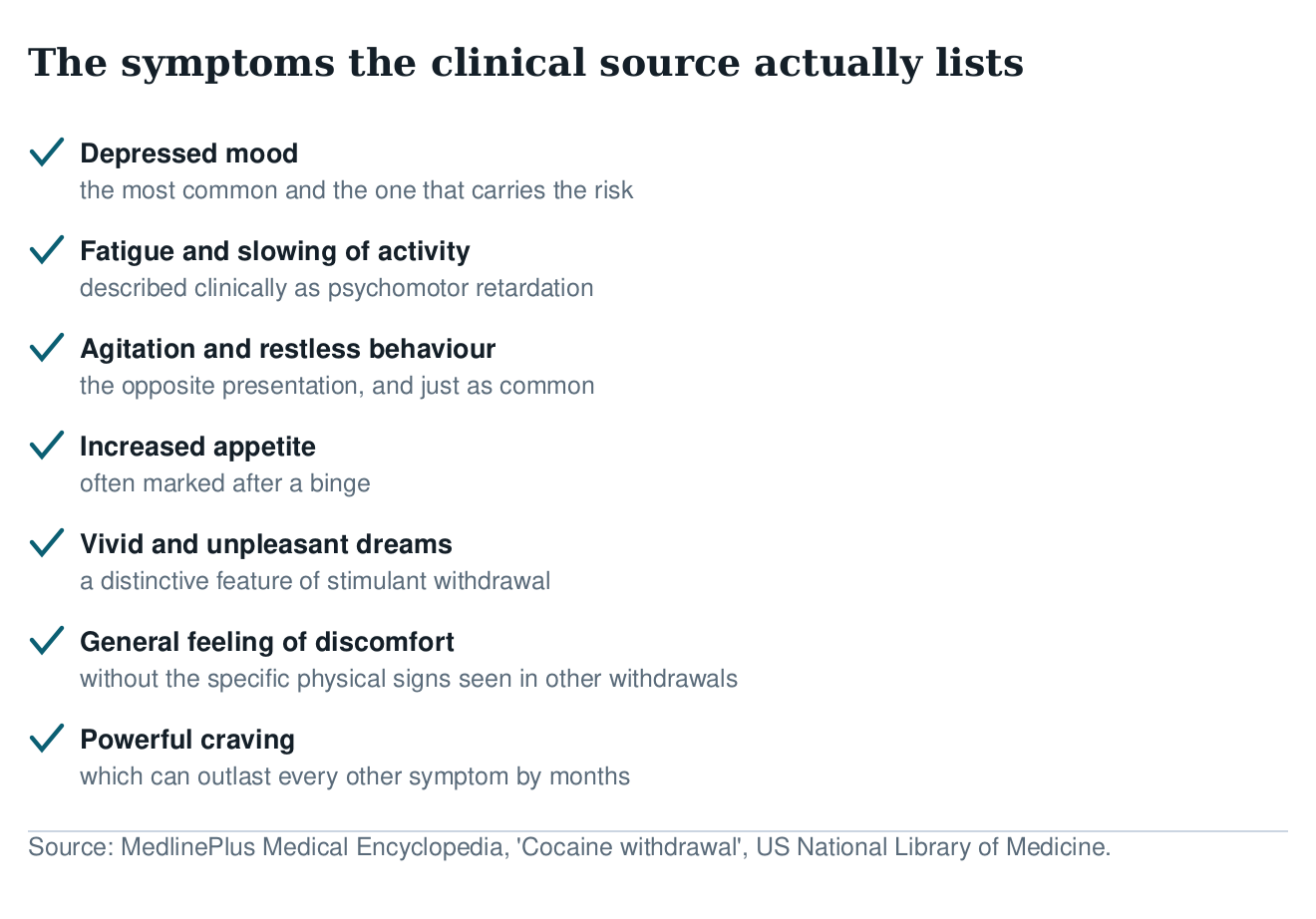
The National Library of Medicine puts it without hedging: when cocaine use is stopped or when a binge ends, a crash follows almost right away. There is no waiting period. What arrives is exhaustion, a flat absence of pleasure, heavy sleep or an inability to sleep at all, anxiety, irritability, and a strong craving for more. Some people get agitation and restlessness instead of the exhaustion, and some get extreme suspicion or paranoia. All of that is the same syndrome presenting differently, not a sign that something unusual is happening.
The week or two after
Sleep and appetite move around, often markedly: increased appetite is on the clinical symptom list, and so are vivid, unpleasant dreams, which people rarely expect and find unsettling. Mood stays low. Cravings stop being continuous and start coming in waves. This is the stretch where most people who are going to return to use do so, and the reason is usually not the symptoms themselves but the absence of anything to do instead.
Weeks three to ten
Physically unremarkable to an observer, which is precisely the problem. Cravings stop following the calendar and start following cues: a street, a payday, a particular person, a time of night. The craving and depression can last for months after stopping long-term heavy use. Someone who expected to feel normal by week three, because a page told them so, interprets this as failure rather than as the expected shape of the thing.
Why the published timelines disagree
Because they are describing different people. Duration and intensity vary with how much was used, for how long, by which route, whether alcohol or other drugs were part of the pattern, and what else is going on psychiatrically. A source that gives you exact day boundaries for all of that is performing precision it does not have. We would rather give you the sequence and tell you honestly where the edges are soft.
Why this withdrawal is easy to underestimate
Cocaine withdrawal often has no visible physical symptoms, such as the vomiting and shaking that accompany withdrawal from heroin or alcohol. That single sentence from the clinical source explains most of what goes wrong around it. The person looks tired and low, which reads as an ordinary bad week. No one calls a doctor for a bad week.
The absence of drama is not the absence of risk
The complications listed for cocaine withdrawal are depression, craving and overdose, and suicide. Withdrawal symptoms may be associated with suicidal thoughts. That is a different risk profile from alcohol withdrawal, not a smaller one: the danger is not that the body fails, it is what a person does while feeling that way with nothing in place. If you are supporting someone through this, the thing to watch is mood and isolation rather than temperature and tremor.
The drink-and-sedative trap
People in cocaine withdrawal frequently reach for alcohol, sedatives, hypnotics or anti-anxiety medication to get through it. The clinical source is direct about why that is a poor idea: long-term use is not recommended because it simply shifts addiction from one substance to another. Short-term use under medical supervision can help. The distinction is supervision, and it is not a technicality: benzodiazepines taken privately to survive a fortnight are how a second dependency starts.
Withdrawal can begin before the drug is gone
Symptoms of withdrawal can occur even if the person is not completely off cocaine and still has some of it in their blood. This matters for how people interpret what they are feeling. Someone tapering, or using less than before, can be in withdrawal while still using, conclude that the symptoms are therefore something else, and go looking for a different explanation.
The part that kills people is not the withdrawal
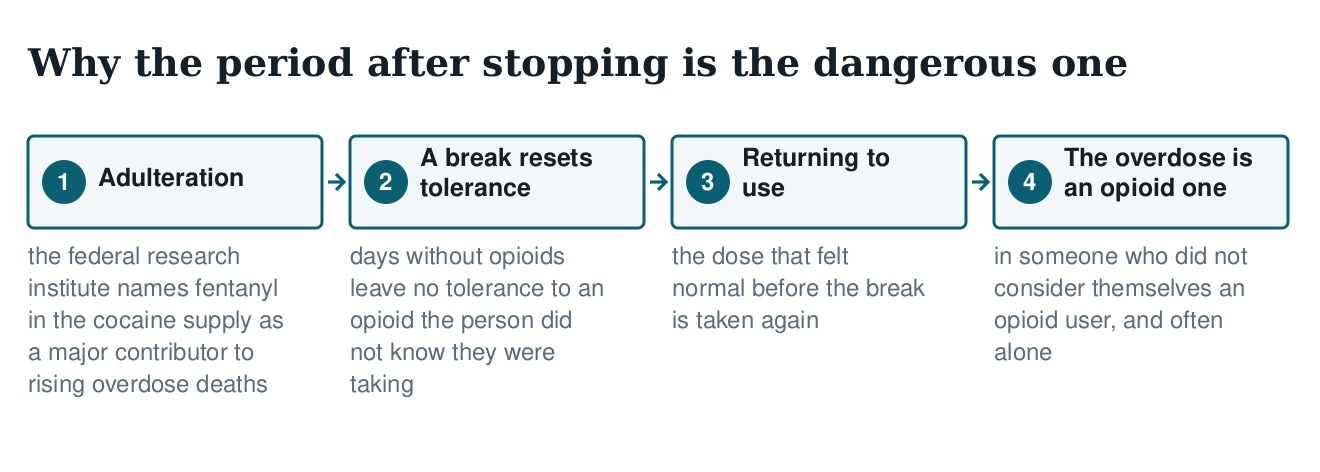
Here is the number that should reframe the whole question. The age-adjusted rate of overdose deaths involving cocaine was 1.3 per 100,000 in 2010. By 2023 it was 8.6, up 4.9 per cent on the previous year. In that same year, the overall drug overdose death rate fell 4 per cent and deaths involving synthetic opioids fell with it. Cocaine went the other way. The federal research institute names the reason: adulteration of cocaine with highly potent fentanyl and related substances is a major contributor to rising overdose deaths.
Why a break makes the next use more dangerous
Tolerance to opioids falls within days of not taking them. Somebody who uses cocaine and has been through a crash, a detox admission, a few days in custody or a fortnight of trying, has no opioid tolerance at all, and may never have had much. If the cocaine they return to contains fentanyl, the dose their body handled before the break is not the dose it handles now. The overdose that follows is an opioid overdose in a person who did not think of themselves as an opioid user, which is also why it so often happens alone and unrecognised.
Naloxone belongs in the house
This is the practical conclusion and almost nobody writing about cocaine withdrawal says it. Naloxone reverses opioid overdose. It does nothing for cocaine and it does no harm if opioids turn out not to be involved, which makes carrying it a decision with no downside. If the person in front of you uses cocaine, the household should have naloxone and somebody in it should know how to use it. Ask the programme whether they supply it; the question also tells you how current their thinking is.
There is no antidote for cocaine itself
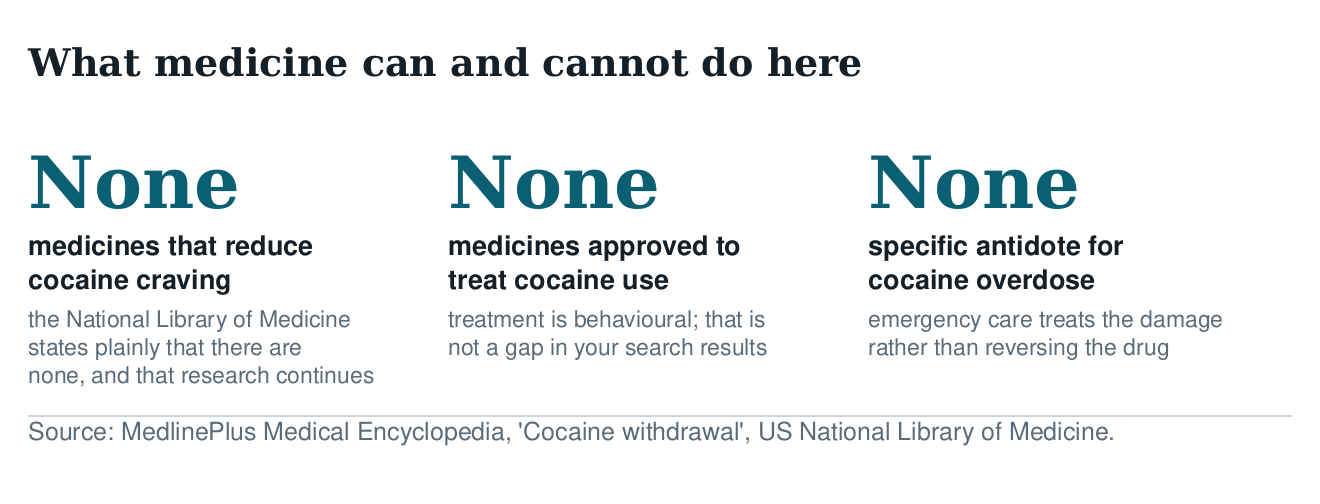
Worth being clear, because the naloxone advice can be misread. There is no specific medicine to treat a cocaine overdose. Emergency care treats what the drug has done: stroke, seizures, irregular heartbeat, heart attack. Naloxone is for the opioid that may be in the same bag, not for the cocaine.
There is no medication for this, and that is not a gap in your search
People search for the cocaine equivalent of buprenorphine and find nothing, then assume they have not looked hard enough. They have. The National Library of Medicine states it as a fact rather than a caveat: presently, there are no medicines to reduce cravings for cocaine, though research is ongoing. The treatments for cocaine use disorder are different types of behavioural therapies. There are no medicines which can treat it.
What gets prescribed anyway, and why
Medication still appears in stimulant treatment, but it is aimed at something specific rather than at the addiction: sleep during the worst of the crash, a co-occurring depression or anxiety disorder that was there before the cocaine or is left behind after it, or a cardiac problem found on examination. That is legitimate and worth having. It is not treatment for the cocaine use disorder, and a programme that presents it as such is overselling.
What the examination is actually for
A physical examination and a history are often all that is needed to diagnose cocaine withdrawal. The testing that gets ordered alongside it is looking for damage rather than confirming the diagnosis: cardiac enzymes and an electrocardiogram for evidence of heart damage, a chest x-ray, blood tests, toxicology and urinalysis. If someone is offered an assessment that involves none of this after years of heavy use, that is a reasonable thing to ask about.
What does work, and how many places actually offer it
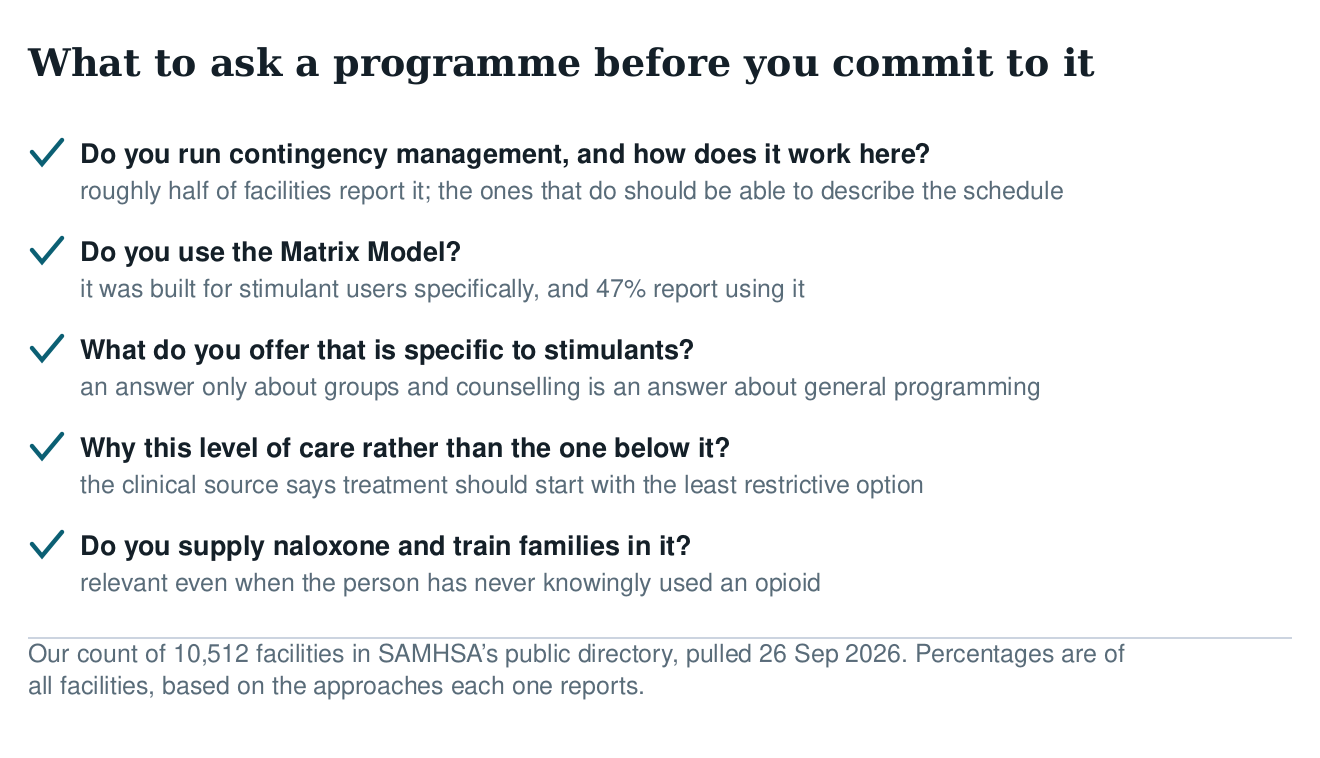
Since the treatment is behavioural, which behavioural treatment matters more here than it does for opioids, where medication carries most of the weight. Two approaches have the strongest evidence for stimulants: contingency management, which provides tangible reinforcement for verified abstinence, and the Matrix Model, an intensive outpatient protocol developed specifically for stimulant users. So we counted how many US facilities actually report them. Nobody publishes that, and it turns out to be the question that separates one programme from another.
| Approach | Share of facilities | Facilities |
|---|---|---|
| Relapse prevention | 94.8% | 9,967 |
| Cognitive behavioural therapy | 93.1% | 9,784 |
| Contingency management | 51.2% | 5,382 |
| Matrix Model | 47.3% | 4,972 |
| Community reinforcement plus vouchers | 10.0% | 1,047 |
Relapse prevention
- Share of facilities
- 94.8%
- Facilities
- 9,967
Cognitive behavioural therapy
- Share of facilities
- 93.1%
- Facilities
- 9,784
Contingency management
- Share of facilities
- 51.2%
- Facilities
- 5,382
Matrix Model
- Share of facilities
- 47.3%
- Facilities
- 4,972
Community reinforcement plus vouchers
- Share of facilities
- 10.0%
- Facilities
- 1,047
Half of facilities, and it depends where you live
Across 10,512 facilities in the federal directory, 51.2 per cent report contingency management and 47.3 per cent report the Matrix Model. Community reinforcement plus vouchers, the other approach with a real evidence base for stimulants, appears at 10 per cent. For contrast, cognitive behavioural therapy is reported by 93.1 per cent and relapse prevention by 94.8 per cent, which means those two tell you almost nothing about a particular programme because almost everyone claims them.
The state spread is wider than the national figure suggests
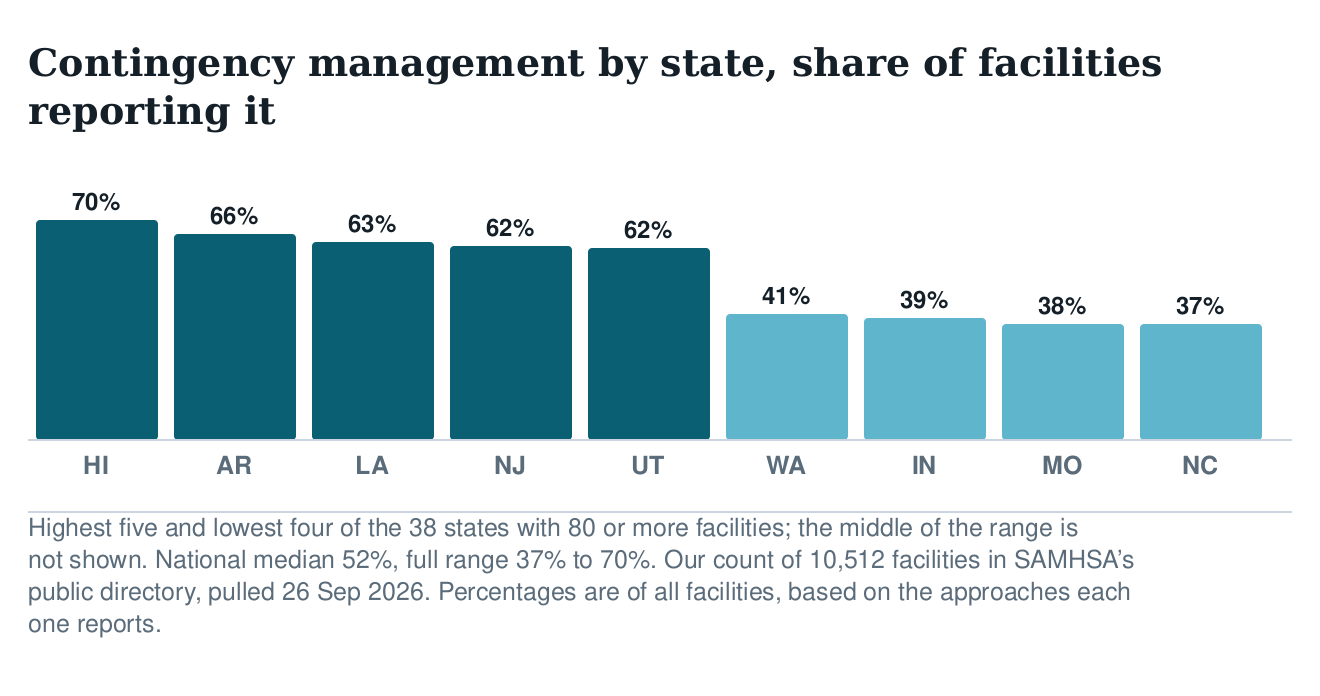
Among the 38 states with 80 or more facilities, the share reporting contingency management runs from 37 per cent to 70 per cent, with a median of 52. Hawaii, Arkansas, Louisiana, New Jersey and Utah sit at the top; North Carolina, Missouri, Indiana and Washington at the bottom. If you are in a low-share state, the approach with the best evidence for your situation is something you will have to ask for by name rather than assume.
What the directory can and cannot tell you
These are self-reported service categories, not audits. A facility ticking contingency management has told the federal directory it does that; it has not proved how well, how often, or with what reinforcement schedule. Treat the number as a filter for the shortlist and the phone call as the actual check. A programme genuinely running contingency management can describe what is reinforced, how abstinence is verified and what the reinforcement is. One that ticked a box will change the subject.
Where this gets treated, and the recommendation most pages skip
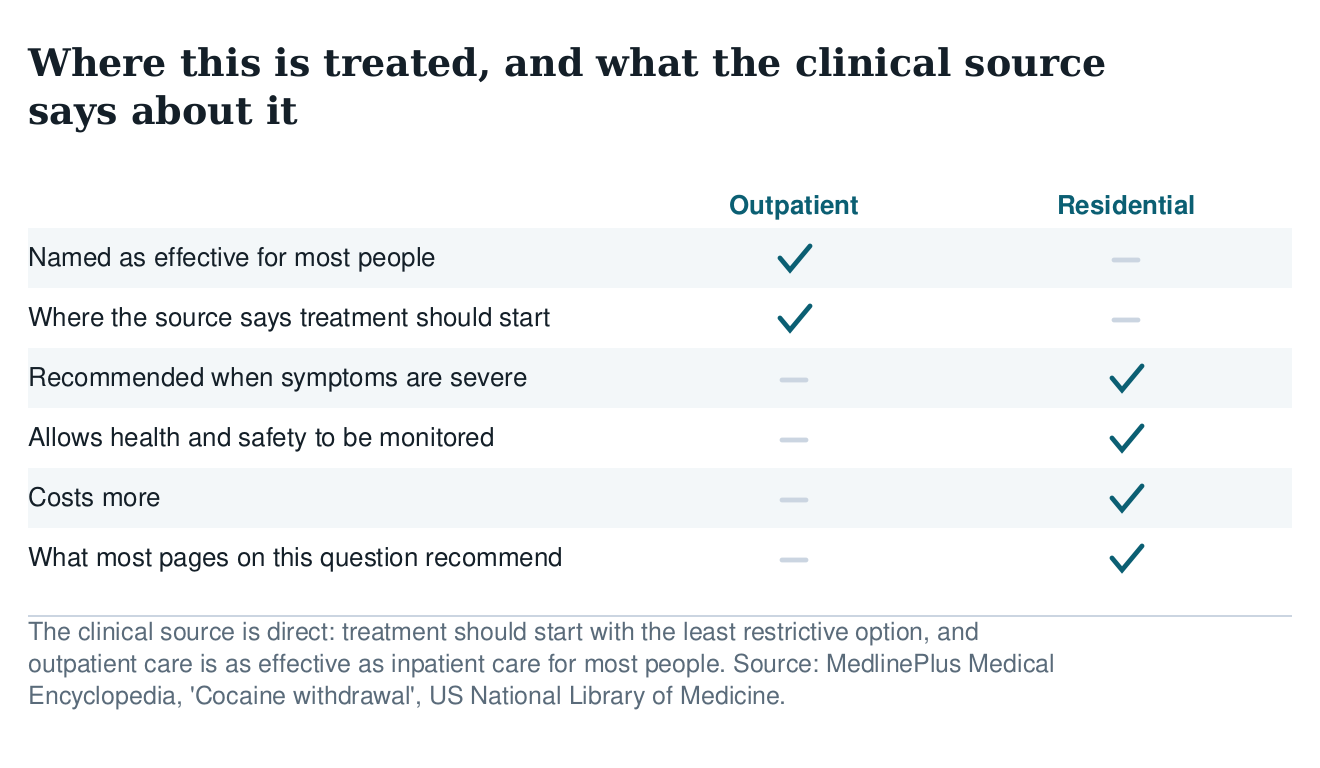
This is the sentence in the clinical source that sits hardest with the rest of the search results. Treatment should start with the least restrictive option, and outpatient care is as effective as inpatient care for most people. Not as a compromise, not as the budget version. As effective, for most people, in the National Library of Medicine encyclopedia.
When residential is the right answer
The same source says that if symptoms are severe, a live-in treatment programme may be recommended, where medicines can be used for the symptoms and health and safety can be monitored during recovery. That is a real indication and it describes a specific situation: severe symptoms, or a home environment that makes the first weeks impossible, or a psychiatric picture that needs watching. It is not the default, and the difference between an indication and a default is several thousand dollars.
Why detox is usually not the step here
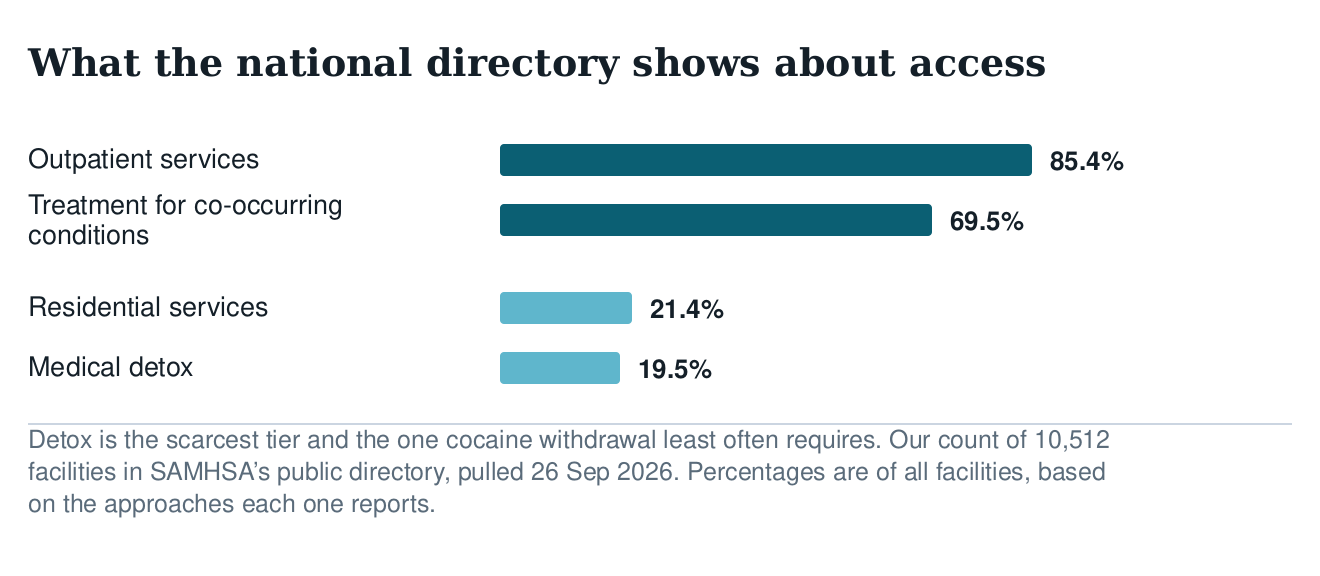
Medical detox exists to manage withdrawal that can hurt you, which for cocaine is rarely the case. In the federal directory, 19.5 per cent of facilities run detox, making it among the scarcer services, and it is the tier cocaine withdrawal least often needs. That is not an argument against being assessed. It is an argument against assuming that the first call should be to a detox unit, and against a programme that routes every stimulant enquiry into one.
When the crash needs a clinician rather than a dark room
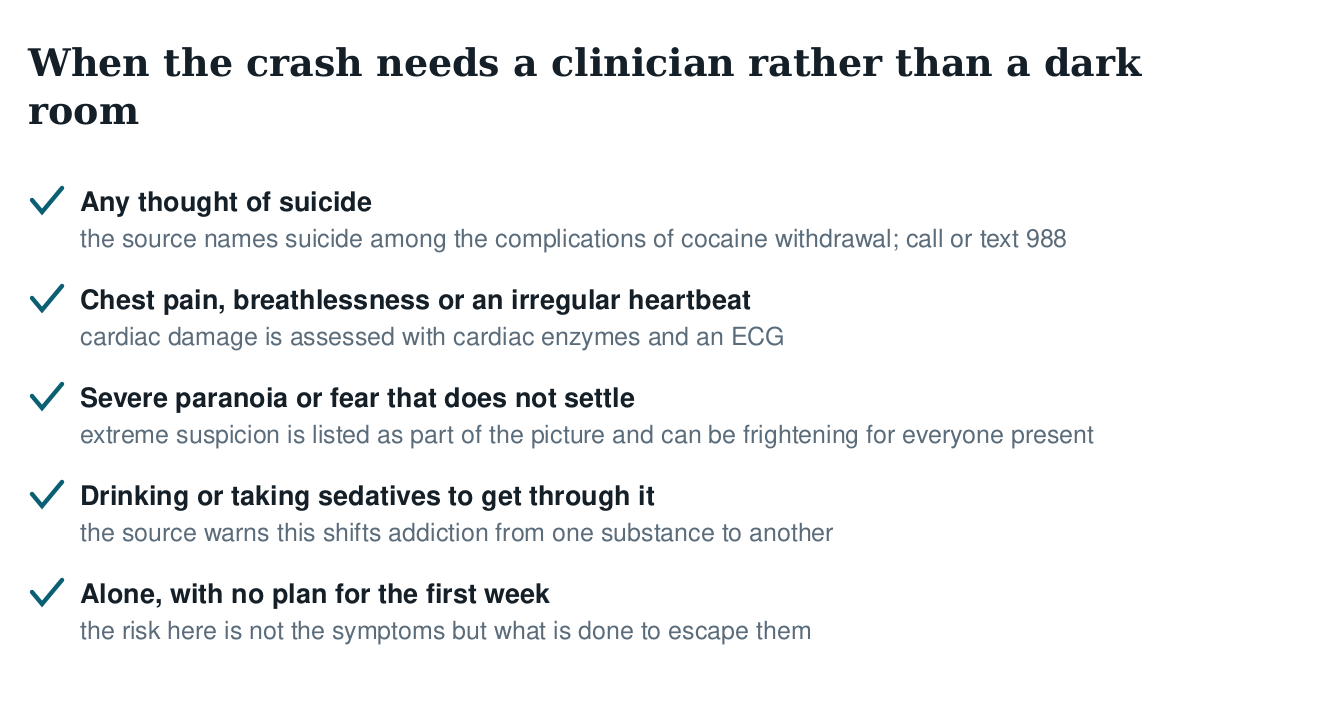
Most cocaine withdrawal is got through without medical care, and saying otherwise would be dishonest. There are specific situations where that changes, and they are worth knowing in advance rather than deciding in the middle of a bad night.
Any thought of suicide
Suicide is named among the complications of cocaine withdrawal, and withdrawal symptoms may be associated with suicidal thoughts. This is the reason not to treat the crash as something to be endured privately. In the US, call or text 988 for the Suicide and Crisis Lifeline. If someone has already attempted, call 911 and do not leave them alone.
Anything cardiac
Chest pain, breathlessness, an irregular heartbeat. Cocaine damages the cardiovascular system and the crash is often when the damage first gets noticed, because it is the first time in a while the person is not stimulated. This is an emergency department question, not a treatment programme question.
Paranoia that does not settle
Extreme suspicion and fear are part of the described picture and usually fade. When they do not, or when they were present during use as well, that needs assessing rather than waiting out, and it changes what kind of programme is appropriate.
What this page cannot tell you
It cannot tell you how long your withdrawal will last, because the duration varies with a history we do not have. It cannot tell you whether you need residential treatment, because that is a clinical judgement made by someone who has assessed you. It cannot tell you what is in the cocaine in your area, which is the fact that would change your risk most and which nobody can tell you reliably. What it can do is give you the sequence to expect, the numbers behind the risk, the name of the treatment worth asking for and an honest count of how many places offer it.
Where this sits in the system of care
Addiction treatment is organised into levels of care, and clinicians choose between them using the ASAM criteria (six dimensions covering withdrawal risk, medical and psychiatric conditions, readiness, relapse risk and, decisively, the environment you return to. Facilities are licensed by the state and many hold additional accreditation from bodies such as the Joint Commission or CARF; that status is worth confirming for any specific programme. Percentages below are our count of how many facilities in the federal directory report offering each level of care.
- Detox19.5% of facilitiesmedical withdrawal management, 3–7 daysDetox vs rehab
- Residential21.4% of facilitieslive on site, 24-hour staffingInpatient vs outpatient
- PHP20–30 structured hours a week, sleep at homePHP vs IOP
- IOP9–19 hours a week, usually compatible with workPHP vs IOP
- Standard outpatient85.4% of facilities1–8 hours a week, the maintenance levelMutual aid options
“Remaining in treatment for an adequate period of time is critical.”
Programmes for specific groups
Facilities also report dedicated programming, and the coverage is wider than most people expect, worth asking about before assuming a programme will not fit. From our count: 42.7% run programmes for adolescents, 39.2% for veterans, 38% for pregnant and postpartum women, and 25% provide services in Spanish. Medication for opioid use disorder is available at 59.2% (buprenorphine) and 13.7% (methadone).
Cost and coverage vary by level: residential care is the tier insurers scrutinise most and almost always requires prior authorisation before admission. See what your plan covers and how to pay without insurance. Family involvement is a standard part of most programmes, and aftercare planning ( step-down to a lower level, sober living, relapse prevention) should be discussed before admission, not at discharge. If a mental health condition is also present, ask specifically whether the programme is staffed for co-occurring disorders: 69.5% of facilities in the directory report treating them, but that is a self-reported field worth confirming.


Common questions
How long does cocaine withdrawal last?
The crash begins almost immediately and the acute phase passes within roughly one to two weeks for most people. Craving and low mood can continue for months after long-term heavy use. The exact duration varies with how much was used and for how long, which is why published day-by-day grids disagree with each other.
Is cocaine withdrawal dangerous?
The withdrawal itself rarely is, and it usually has none of the visible physical symptoms of alcohol or opioid withdrawal. The listed complications are depression, craving and overdose, and suicide. So the risk is real but it is a mood and behaviour risk rather than a physical one, and it is highest for someone going through it alone.
Is there a medication for cocaine withdrawal or craving?
No. The National Library of Medicine states there are presently no medicines to reduce cocaine cravings and that treatment is behavioural. Medication may still be used for sleep, for a co-occurring psychiatric condition or for a cardiac problem, but not for the cocaine use disorder itself.
Do I need a medical detox to stop using cocaine?
Usually not. Detox manages withdrawal that can be medically dangerous, which cocaine withdrawal generally is not. A live-in programme is recommended where symptoms are severe. If a programme routes every stimulant enquiry straight into a detox admission, ask what specifically it is treating.
What treatment actually works for cocaine?
Contingency management, which reinforces verified abstinence, and the Matrix Model, an intensive outpatient protocol built for stimulant users, have the strongest evidence. In our count of the federal directory, 51.2% of facilities report the first and 47.3% the second, so it is worth asking for them by name.
Why should someone who uses cocaine keep naloxone?
Because fentanyl in the cocaine supply is named by the federal research institute as a major contributor to rising overdose deaths, and a few days without use leaves no opioid tolerance. Naloxone reverses an opioid overdose, does nothing for cocaine, and causes no harm if opioids were not involved.
Are cocaine deaths actually going up?
Yes. The age-adjusted rate of overdose deaths involving cocaine went from 1.3 per 100,000 in 2010 to 8.6 in 2023, a 4.9% rise on 2022, during a year when the overall drug overdose rate fell 4% and synthetic opioid deaths fell.
Is inpatient rehab better than outpatient for cocaine?
Not for most people, according to the clinical source: treatment should start with the least restrictive option, and outpatient care is as effective as inpatient care for most people. Residential care is indicated where symptoms are severe or the home situation makes the early weeks unworkable.
Can I use alcohol or sleeping pills to get through the crash?
Short-term use under medical supervision can help. The clinical source warns against doing it privately or for long, because it simply shifts addiction from one substance to another. If you find yourself drinking to get through cocaine withdrawal, that is a reason to involve a clinician rather than a reason to keep going.
Can withdrawal start before I have completely stopped?
Yes. Symptoms can occur even while some cocaine is still in the blood, which is why people cutting down often feel them and conclude the symptoms must be something else.
Sources
- MedlinePlus Medical Encyclopedia: Cocaine withdrawal, US National Library of Medicine
- MedlinePlus: Cocaine, including the statement that there are no medicines to treat cocaine use disorder
- NCHS Data Brief No. 522: Drug Overdose Deaths in the United States, 2003-2023 (CDC)
- NIDA: Cocaine, on adulteration with fentanyl as a contributor to overdose deaths
- SAMHSA FindTreatment.gov, the public directory we counted
Compare levels of care
Check what your plan covers
How this page was made
- Who wrote it:
- the Treatment Compass editorial team : researchers and writers, not clinicians. No doctor has reviewed this page, and we do not claim otherwise. What that means in practice: we report what public clinical sources say and show you where to read them, rather than offering a clinical opinion of our own.
- Checked against:
- 5 primary sources listed above: federal agency material and published clinical criteria. Where a figure varies by state, plan or facility, we say so instead of publishing a number that looks authoritative and is not.
- Original analysis:
- the facility proportions on this page are our own count of SAMHSA’s public directory. The full method is documented , including what we count, what we deliberately do not publish, and an error the approach caught. You can repeat the pull and check the numbers.
- Last reviewed:
- . This date changes when the content is actually re-checked, not automatically on every visit.
- What this page is not:
- a medical recommendation, a diagnosis, or a referral. Decisions about levels of care and medication belong with a clinician who knows your history. We do not operate facilities, take placement fees, or receive payment for sending anyone anywhere.
Related on this site
- Opioid withdrawal timelinethe other direction: a withdrawal that is physically unmistakable and has a medication that prevents it
- Detox vs rehabwhat a detox unit actually does, and why cocaine rarely calls for one
- Inpatient vs outpatientthe choice this page says should start with the least restrictive option
- Relapse warning signsfor the weeks when cravings start following cues rather than the calendar
More guides
- How to Get Someone Into RehabYou usually cannot force an adult into addiction treatment. What works is removing the obstacles, picking the moment, and knowing the legal exceptions.
- Paying for Rehab Without InsuranceState-funded programmes, sliding-scale fees, federal block grants and payment plans. What each option actually is, who qualifies, and how to reach it.
- Rehab Rules: What You Can and Cannot Do in TreatmentWhat treatment facilities restrict and why: phones, visitors, relationships, leaving early. Rules vary by level of care, so here is what to ask first.
- Suboxone Withdrawal Timeline: Why It Starts Late and Lasts LongerWhy buprenorphine withdrawal is delayed, what the FDA label says about tapering, and our count of how many US facilities will actually help you come off.
- 7-OH Withdrawal Timeline: What It Is and Why Stopping Is HardWhat 7-hydroxymitragynine actually is, why withdrawal behaves like an opioid, and what the Federal Register says about the ban as of September 2026.
- Meth Withdrawal Timeline: What the Evidence Actually SaysWhere the 7-to-10-day figure comes from, why NIDA and the original study disagree, and our count of how few US facilities offer stimulant detox.
- Opioid Withdrawal Timeline: What Happens, and WhenSymptoms start around 12 hours after short-acting opioids and 30 after methadone. Fentanyl changes the picture, and the real danger comes after it ends.
- Relapse Warning Signs: What Comes Before Using AgainRelapse starts weeks before anyone picks anything up. The published model names three stages, and the early one has no thoughts of using in it at all.
- Rehab for Professionals: What Is Actually DifferentLicensed professionals get the best documented outcomes, and the most monitoring. What that trade involves, state by state.
- What Happens in Rehab: The Day, the Week, the MonthAdmission day is paperwork, not therapy. Most of the rest is group work. An honest account of the schedule, the therapies by name and the emotional arc.
- Court-Ordered Rehab: How It Works and What the Evidence ShowsA judge can order treatment by several routes, each with different consequences. Drug court, civil commitment and what each means.
- Sober Living Rules: What They Are and What Is EnforceableAbstinence, testing, curfew, chores and rent are near-universal. What is negotiable, what the law protects, how to spot a bad house.
- How Long Does Suboxone Stay in Your System?Buprenorphine has a 24 to 42 hour half-life. Urine tests find it for about a week, hair for months, and the blocking effect fades sooner than the drug does.
Weighing levels of care? See PHP vs IOP and what your insurance covers.
This page is information, not medical or legal advice. Laws on commitment and treatment differ by state. If you are in crisis, call or text 988 in the US, or reach the SAMHSA National Helpline at 1-800-662-4357 — free, confidential, 24/7.