Meth Withdrawal Timeline: What the Evidence Actually Says
Last updated
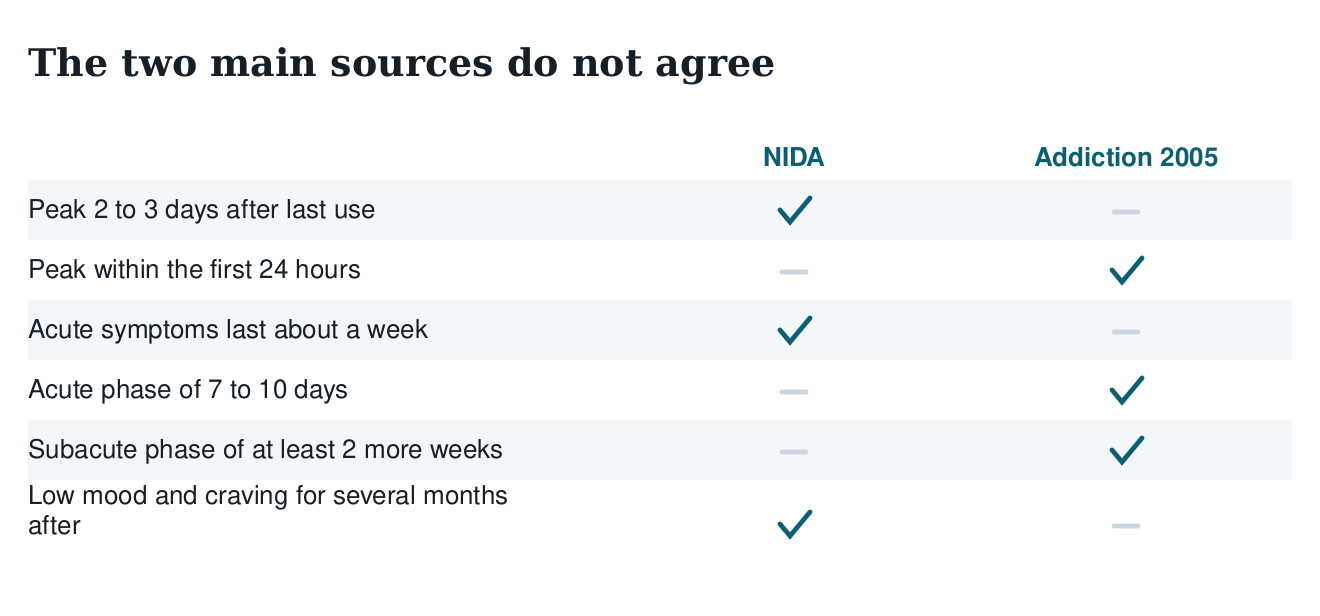
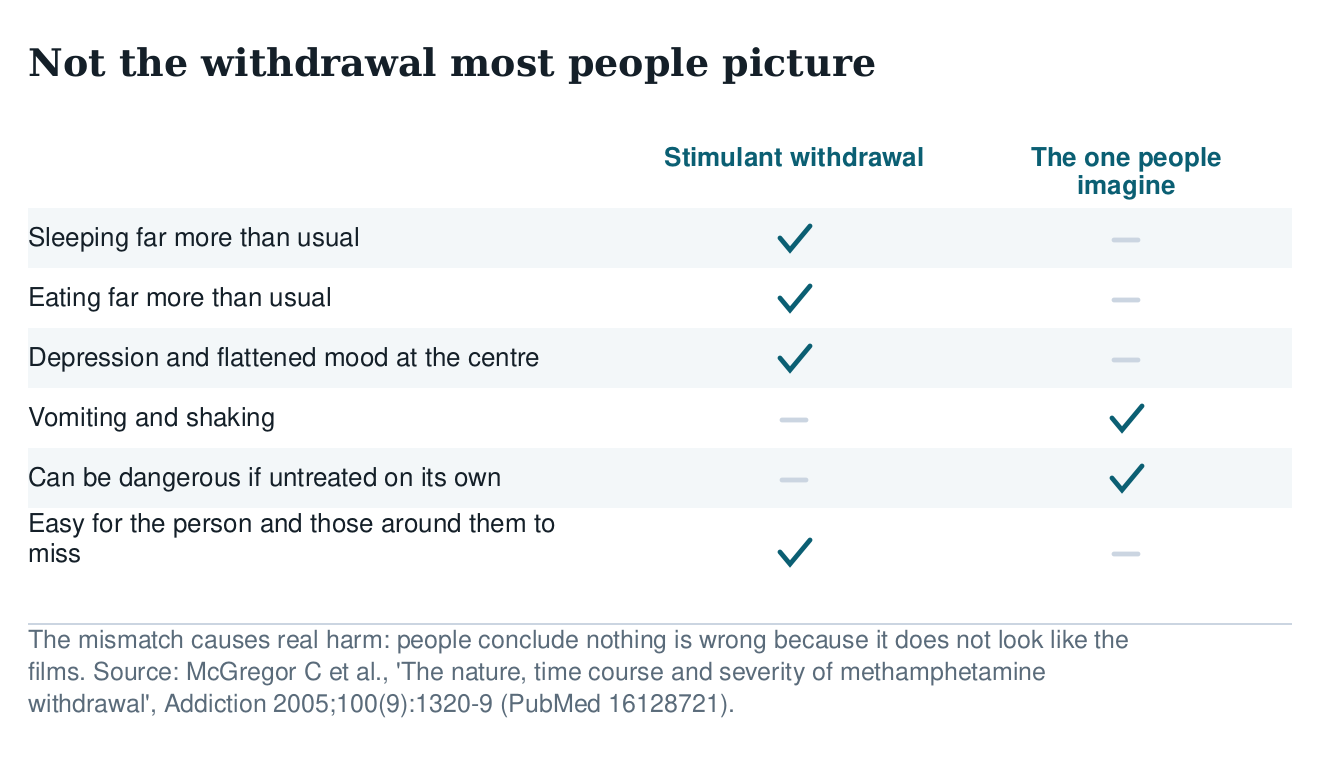
Almost every page on this subject gives the same timeline: a crash in the first day or two, an acute phase of seven to ten days, then a longer tail. That figure is real, and it traces back to a single study published in Addiction in 2005 that followed 21 inpatients daily for three weeks. It is worth knowing that, because the authorities do not entirely agree with each other. NIDA states that symptoms peak two to three days after last use and may last about a week; the 2005 study found severity declining from a high peak within 24 hours across an acute phase of seven to ten days, with a subacute phase of at least two more weeks. The shape most people are unprepared for is the same in both: sleeping and eating far more than usual rather than the vomiting and shaking they expected.
The short version
- The peak is disputed — NIDA says 2 to 3 days after last use; the 2005 Addiction study found the peak inside the first 24 hours
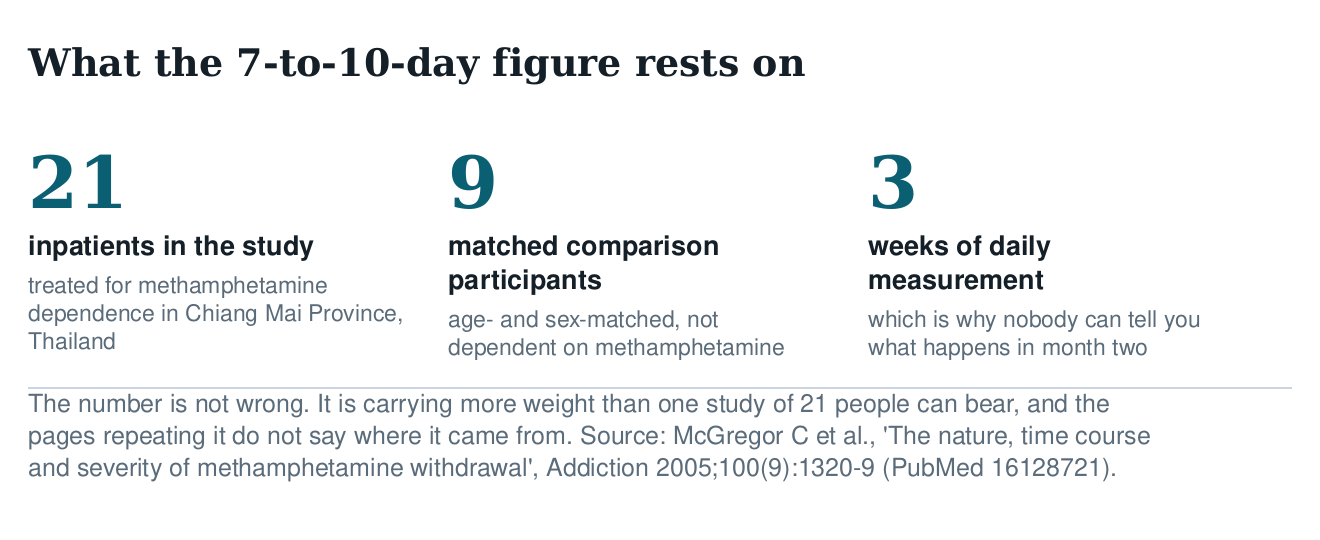
- The 7-to-10-day figure has one source — a 2005 study of 21 inpatients in Thailand, measured daily for three weeks. Real, but a thin base for a number printed everywhere as fact
- It looks like sleep, not sickness — the acute phase is characterised by increased sleeping and eating plus depression-related symptoms, not the physical withdrawal people picture
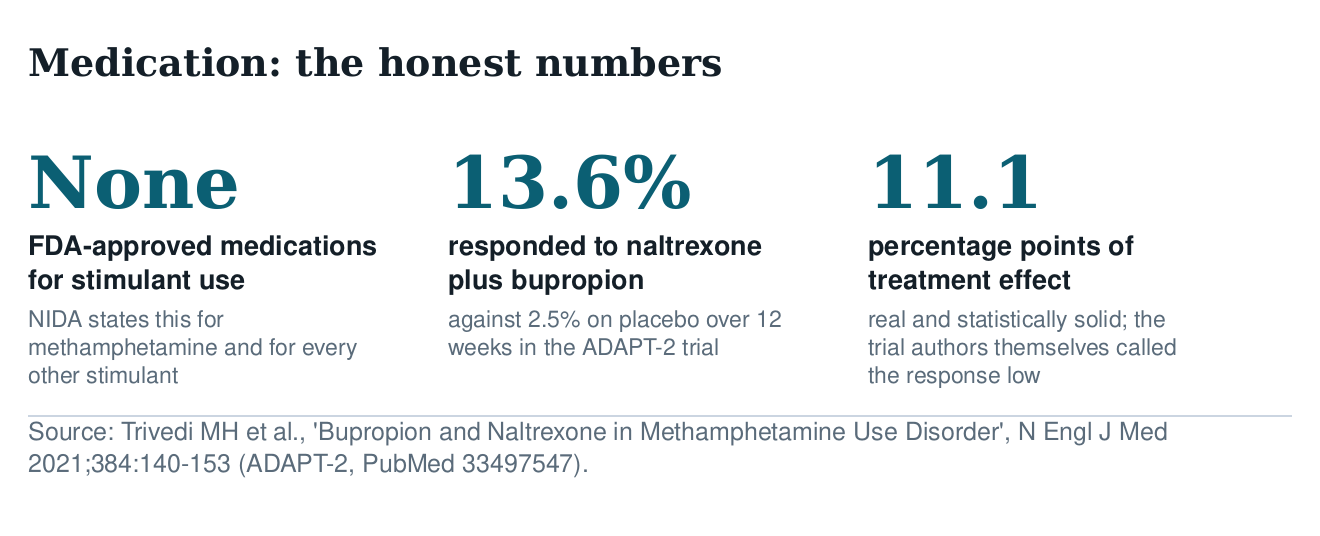
- No approved medication exists — NIDA states there is no FDA-approved medication for methamphetamine or any stimulant use disorder. The best trial showed a 13.6% response against 2.5% on placebo
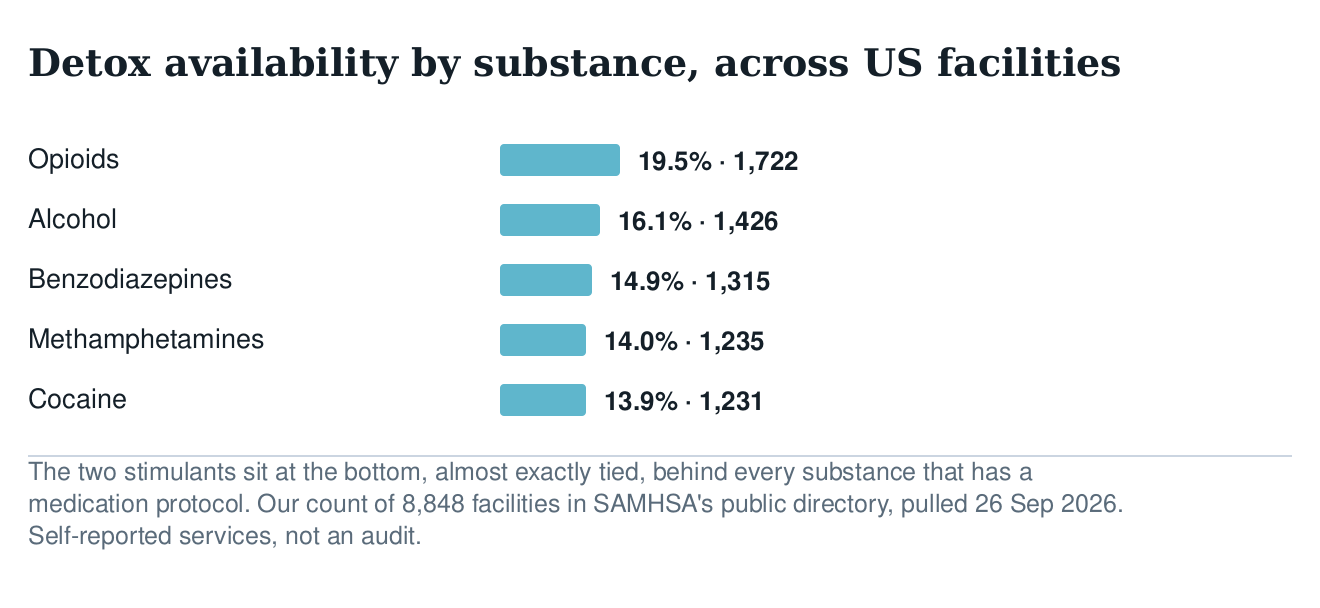
- Stimulant detox is the least offered — we counted 8,848 facilities: 14.0% report methamphetamine detox against 19.5% for opioids
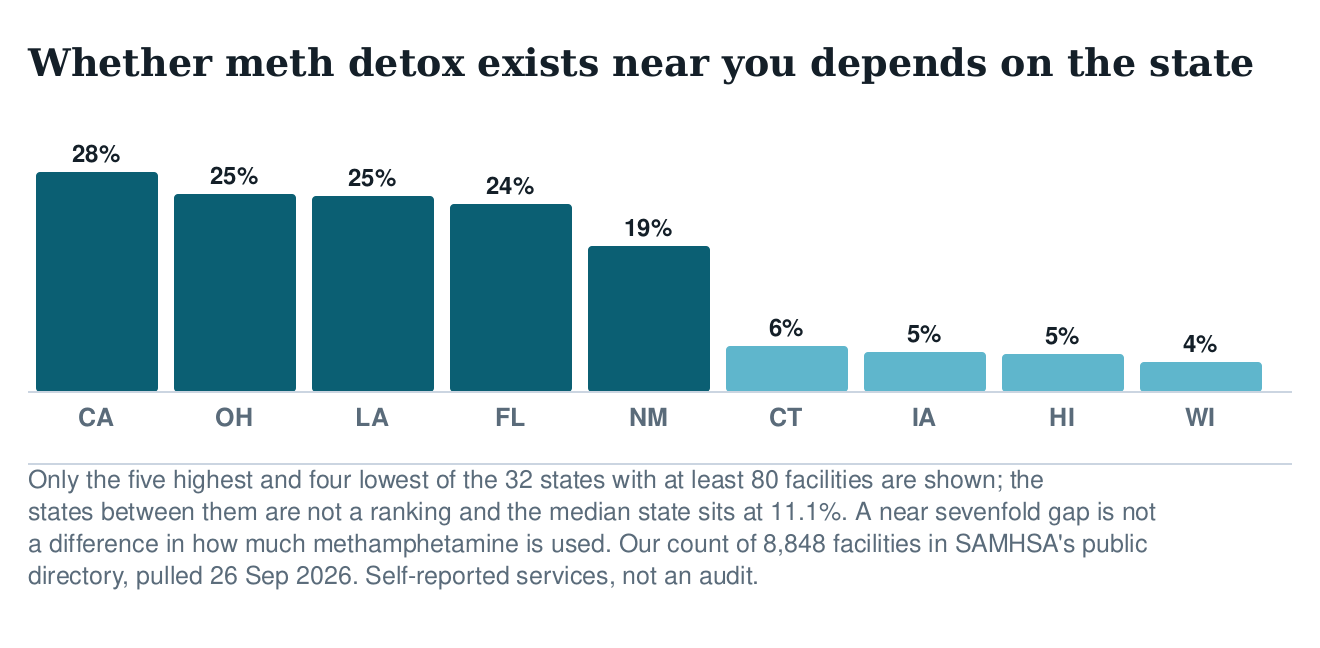
- And it depends on your state — from 4.0% of facilities in Wisconsin to 27.6% in California, a near sevenfold gap. Median state 11.1%
Stimulant detox is the least available, counted
Our analysisThe federal directory records detoxification separately for each substance, so we pulled all of it and counted. Methamphetamine sits at the bottom alongside cocaine, well behind the substances that have a medication protocol.
- 14.0%
- offer methamphetamine detoxification
- 1,235 of 8,848 facilities in our pull of the federal directory on 26 September 2026
- 19.5%
- offer opioid detoxification
- 1,722 facilities. The gap is roughly 490 places, and the likely reason is that opioid detox has a drug protocol and stimulant detox does not
- 13.9%
- offer cocaine detoxification
- the two stimulants are almost exactly tied at the bottom of the five substances tracked
- 52.9%
- offer contingency management
- the behavioural treatment NIDA names as best studied and most associated with success for stimulants
- 46.2%
- offer the Matrix Model
- the intensive outpatient protocol developed specifically for stimulant users
- 4.0-27.6%
- the range between states
- share of facilities offering methamphetamine detox, from Wisconsin to California across the 32 states with at least 80 facilities. Median state 11.1%
- 21.7%
- offer residential or 24-hour care
- against 79.2% offering regular outpatient. Where you get through the week is often the practical question
How we got this: we pulled the full public listing from SAMHSA’s FindTreatment.gov on , removed duplicate entries by name, street and ZIP, and counted how many of the 10,233 remaining facilities report each service. SAMHSA publishes the directory; it does not publish these proportions — see how the count is made. Repeat the pull and you will get the same numbers, give or take facilities that opened or closed since.
What these numbers cannot tell you: they are self-reported by facilities, they describe availability rather than quality, and a national proportion says nothing about what is open near you this week. Use them to know what to ask for, not to decide where to go.
What meth withdrawal looks like, and why it surprises people
One naming point first, because it decides whether this page is the one you want. Crystal meth is methamphetamine: the same drug in a crystalline form that is usually smoked, sold under names including ice, glass and Tina. Crystal meth withdrawal and methamphetamine withdrawal are the same syndrome, and everything below applies to both. The picture most people carry of withdrawal comes from films about heroin or from alcohol: vomiting, shaking, sweating through a mattress, which is what opioid withdrawal actually looks like. Stimulant withdrawal does not work that way, and the mismatch causes real harm because people conclude that nothing is wrong with them. The 2005 study that underpins the standard timeline described the acute phase as characterised by increased sleeping and increased eating, together with a cluster of depression-related symptoms and, less severely, anxiety and craving. Sleeping for most of two days and waking up ravenous is not a sign that you got away with it.
Withdrawal can happen without a diagnosis
NIDA puts this plainly: after someone who uses methamphetamine repeatedly stops, they may quickly experience withdrawal symptoms even if they do not have stimulant use disorder. Dependence of the physical kind and a diagnosable disorder are different things, and the first does not wait for the second. People who do not consider themselves addicted are often the most confused by what happens when they stop.
The symptoms that actually dominate
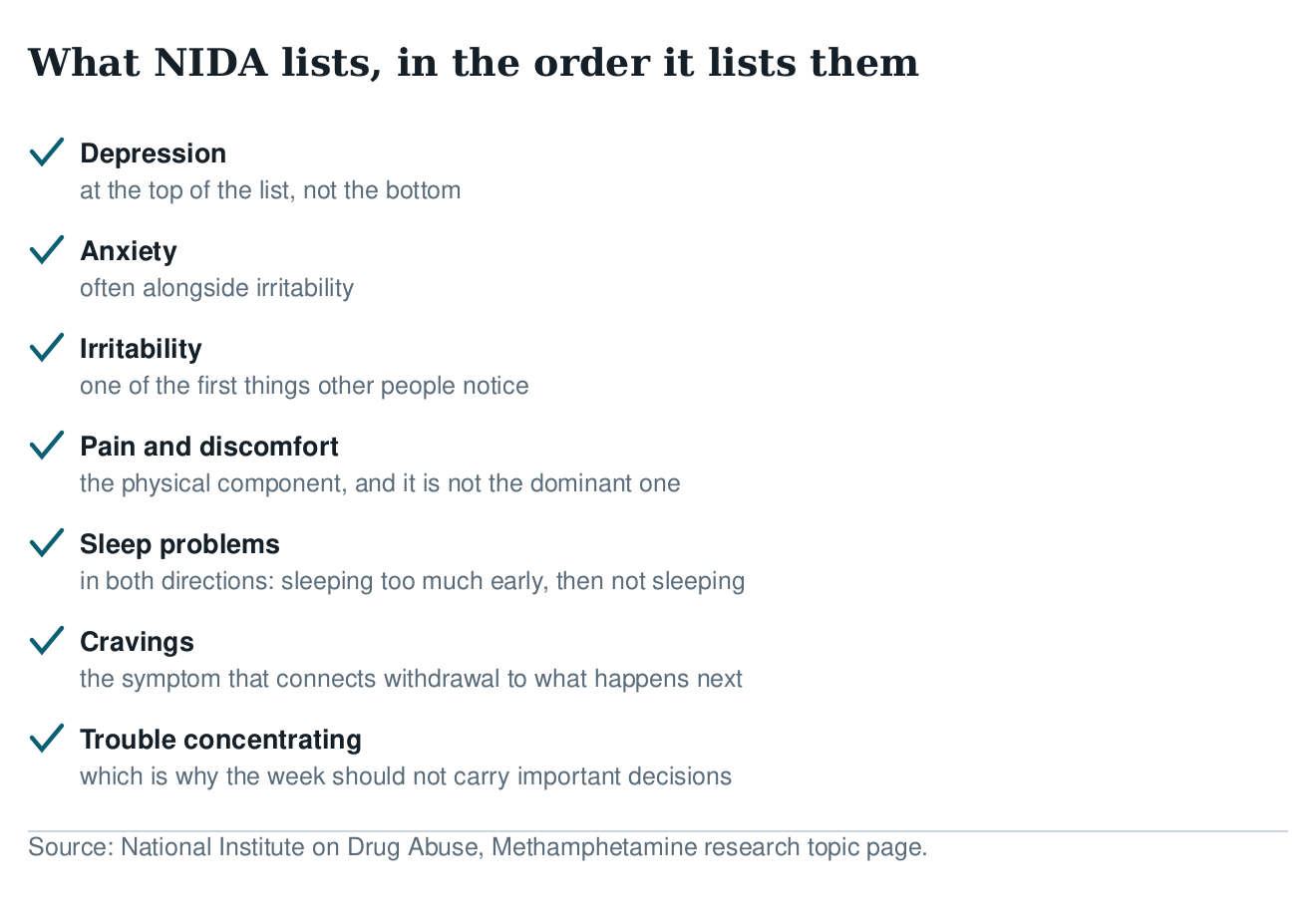
NIDA lists depression, anxiety, irritability, pain and discomfort, sleep problems, cravings and trouble concentrating. Note what is at the top of that list and what is absent from it. This is largely a mood and sleep event with a body attached, not the reverse, which is why it is so often missed by people around the person and by the person themselves.
Where the seven-to-ten-day figure actually comes from
Run this search and you will find the same range on page after page, stated without a source. It comes from McGregor and colleagues, published in Addiction in 2005 under the title The nature, time course and severity of methamphetamine withdrawal. Google currently ranks that paper second for this query, above most of the commercial pages repeating it. The study followed 21 inpatients being treated for methamphetamine dependence at a facility in Chiang Mai Province, Thailand, with nine age- and sex-matched non-dependent people as a comparison group, measured daily for the first three weeks of abstinence.
What it found
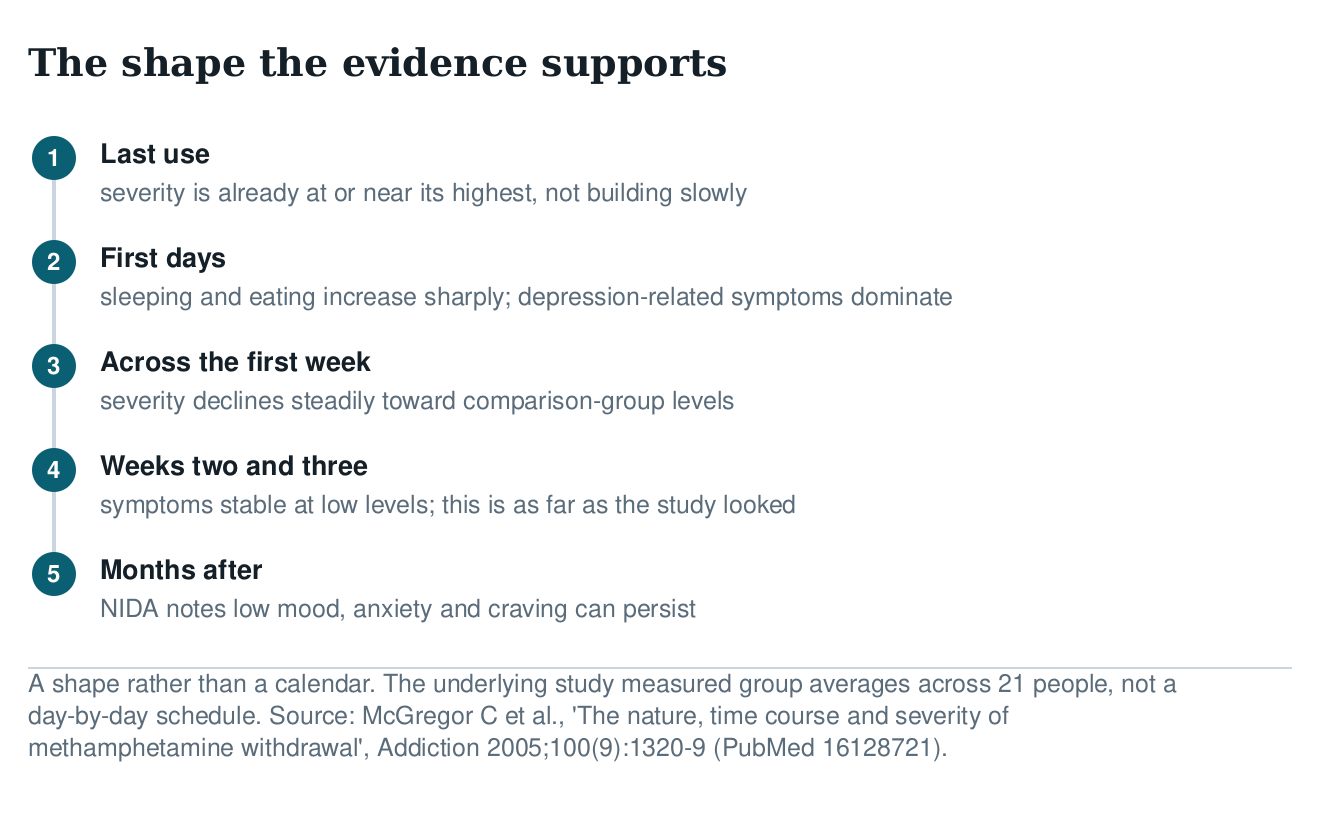
Withdrawal severity declined from a high initial peak within 24 hours of last use, falling to near comparison-group levels by the end of the first week. The authors concluded there were two phases: an acute phase lasting seven to ten days during which overall severity declined in a linear pattern from that high peak, and a subacute phase lasting at least a further two weeks, during which most symptoms remained stable at low levels.
What a sample of 21 can and cannot tell you
It can establish that a withdrawal syndrome exists, describe its shape, and show that it resolves rather than persisting indefinitely. That is genuinely valuable and it was not obvious beforehand. What it cannot do is tell you the distribution across the whole population of people who use methamphetamine, or how a group of inpatients in one Thai treatment facility in the early 2000s compares with someone using a different supply two decades later. The number is not wrong. It is just carrying more weight than one study of 21 people can bear, and nobody repeating it says so.
The instruments they used
For anyone searching for a meth withdrawal scale or assessment tool, this is where the measurement came from: the Amphetamine Withdrawal Questionnaire, a modified version of the Cocaine Selective Severity Assessment, the Clinical Global Impression scale, and the St Mary’s Hospital Sleep Questionnaire, completed daily. These are research and clinical instruments rather than self-tests. A score on one describes severity at a moment; it does not decide treatment on its own.
Why the published timelines disagree
Put the two most authoritative sources side by side and they do not match. NIDA states that symptoms peak two to three days after last use and may last for a week. The 2005 study found severity at its highest within 24 hours and declining from there across seven to ten days. Both are describing the same syndrome, and the gap between them is not a scandal. It is what a thin evidence base looks like when different groups measure with different instruments in different populations.
What to do with a disagreement like this
Not average them, and not pick the one you prefer. The useful reading is that the first week is the hard part, that the worst of it arrives early rather than building slowly over a fortnight, and that the precise hour of the peak is not something anybody can tell you about yourself. Plan for the week, expect the tail, and treat any page offering an hour-by-hour schedule as more confident than the evidence permits.
The subacute phase is the part that gets underestimated
NIDA states that after the acute phase, a person may still experience low mood, anxiety and cravings for several months. The 2005 study saw symptoms stable at low levels through at least the second and third weeks, which is as far as it looked. Months of flattened mood is a different problem from a bad week, and it is the phase during which people most often conclude that recovery is not working; the warning signs worth knowing belong to this stretch, not to the first week.
The stages, named plainly
People search for the stages of methamphetamine withdrawal, and the term meth withdrawal syndrome, expecting a numbered sequence. Here is the sequence as the evidence supports it, with the caveat that the boundaries are descriptive rather than measured: a first phase in which severity is at its highest and sleep and appetite increase sharply, an acute phase of roughly a week to ten days during which severity declines steadily, and a subacute phase of at least a further two weeks in which symptoms sit at low levels. Beyond that, low mood and craving can persist for months.
Why nobody can give you a day-by-day chart
Because the underlying study measured group averages across 21 people, not a schedule. A chart that tells you what day four will feel like is an illustration of an average, presented as a forecast. The honest version is a shape rather than a calendar, and the shape is: worst early, better across the first week, long low tail.
How dangerous is it
Stimulant withdrawal is not generally considered life-threatening in the way that untreated alcohol or benzodiazepine withdrawal can be, and that distinction is worth holding on to because it is frequently blurred by pages selling medical detox. The dangers here are different in kind. Severe depression during the acute and subacute phases is the one that matters most, and it deserves to be taken seriously rather than waited out. Paranoia or psychotic symptoms that began during use can persist into the period after stopping. Neither of those is a reason to avoid stopping; both are reasons not to do it entirely alone.
When hospital care is the right answer
When there are psychotic symptoms, when mood drops to the point of thoughts of self-harm, when there are medical complications from the period of use such as cardiac symptoms, or when other substances are involved that do carry dangerous withdrawals, particularly alcohol and benzodiazepines. The combination is common and it changes the risk picture entirely, because the meth part may be the less urgent half.
Medication: what exists and what it does
NIDA states it without hedging: there is no FDA-approved medication for methamphetamine use disorder or for any other stimulant use disorder. That is the correct starting point for any conversation about medication here, and it is the fact most often omitted by pages that go on to discuss treatment options. What exists is research, and one trial in particular is worth knowing about because it is both the best evidence available and considerably more modest than its coverage suggested.
The ADAPT-2 trial, in the numbers it reported
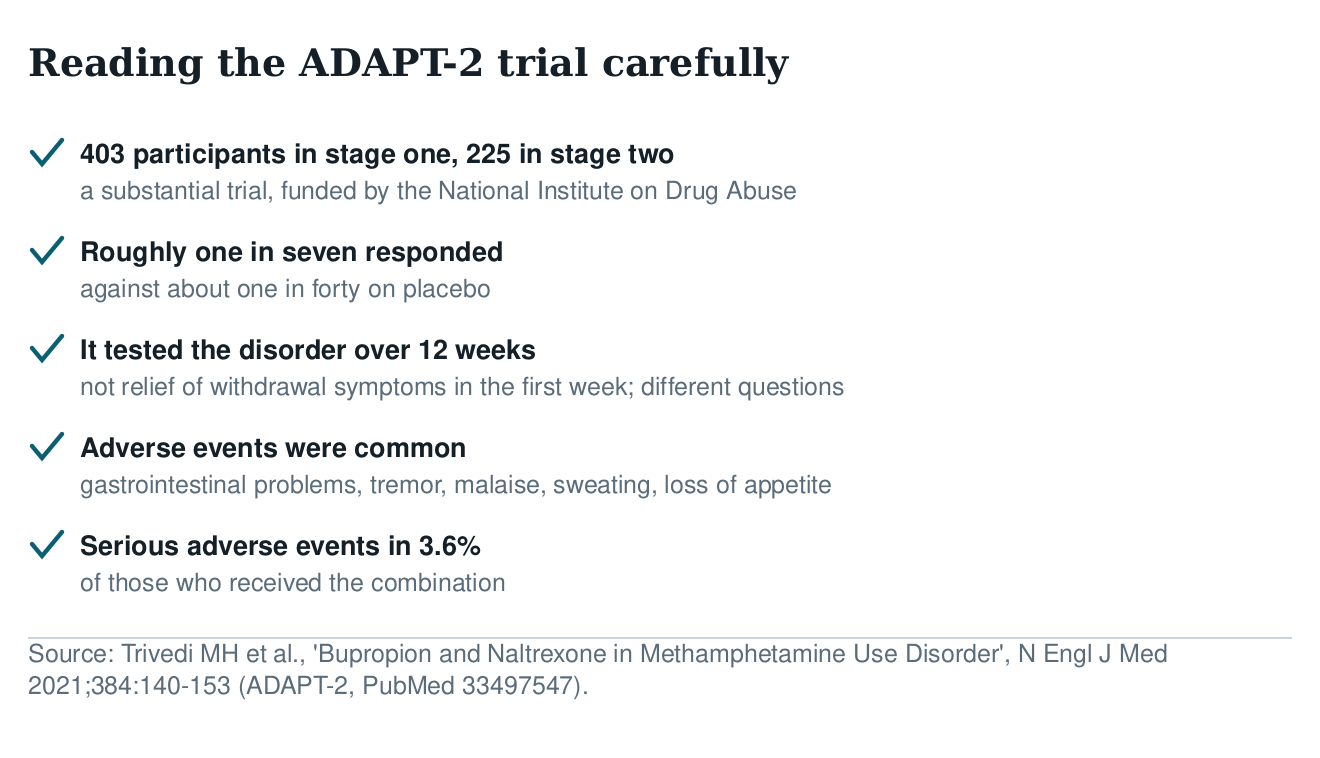
Published in the New England Journal of Medicine in 2021 and funded by the National Institute on Drug Abuse, ADAPT-2 tested extended-release injectable naltrexone plus oral extended-release bupropion against placebo, with 403 participants in the first stage and 225 in the second. The weighted average response across the two stages was 13.6 per cent with the combination against 2.5 per cent with placebo, an overall treatment effect of 11.1 percentage points. The authors described the response over 12 weeks as low but higher than placebo. Adverse events included gastrointestinal problems, tremor, malaise, excessive sweating and loss of appetite, with serious adverse events in 3.6 per cent of those who received the combination.
How to read that honestly
Roughly one in seven responded, against one in forty on placebo. That is a real effect, it is statistically solid, and it is not a cure. It also tested treatment for the disorder over twelve weeks, not relief of withdrawal symptoms in the first week, and those are different questions. Anyone offering you medication for meth withdrawal specifically is working beyond the evidence, which does not automatically make them wrong but does mean you should ask what they are basing it on.
What does work
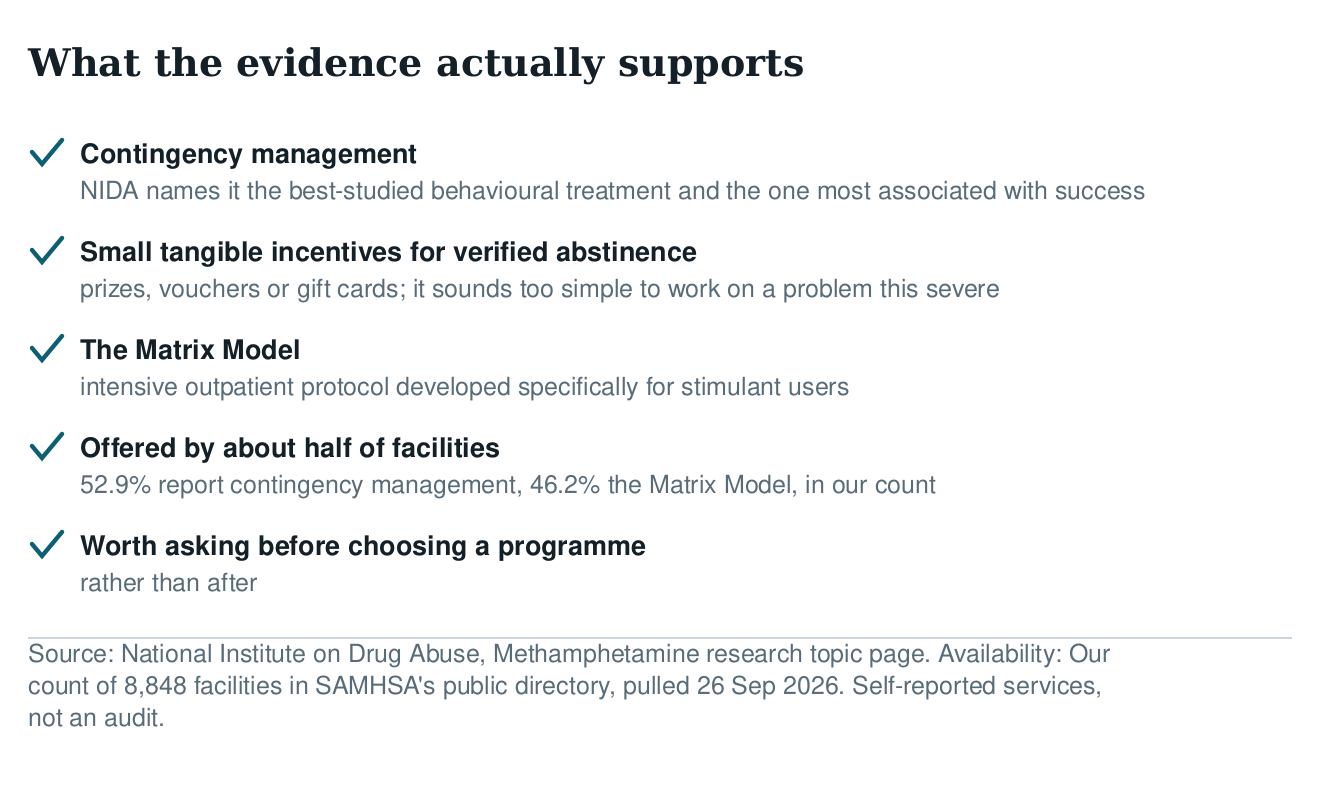
Since there is no medication carrying the weight, the behavioural treatment is not a supplement to the real thing, it is the real thing. NIDA names the best-studied form and the one most associated with treatment success: contingency management, which offers small tangible incentives such as prizes, vouchers or gift cards for verified abstinence. It sounds too simple to work on a problem this severe, which is part of why it remains underused, and the evidence for it in stimulant use disorder is stronger than for anything else on offer.
How many places actually offer it
We counted. Across 8,848 facilities in the federal directory, 52.9 per cent report contingency management or motivational incentives and 46.2 per cent report the Matrix Model, the intensive outpatient protocol developed specifically for stimulant users. So roughly half do and roughly half do not, which makes it a reasonable question to ask before choosing a programme rather than after. Our cocaine page carries the same count broken down by state.
Meth detox: what the word actually covers
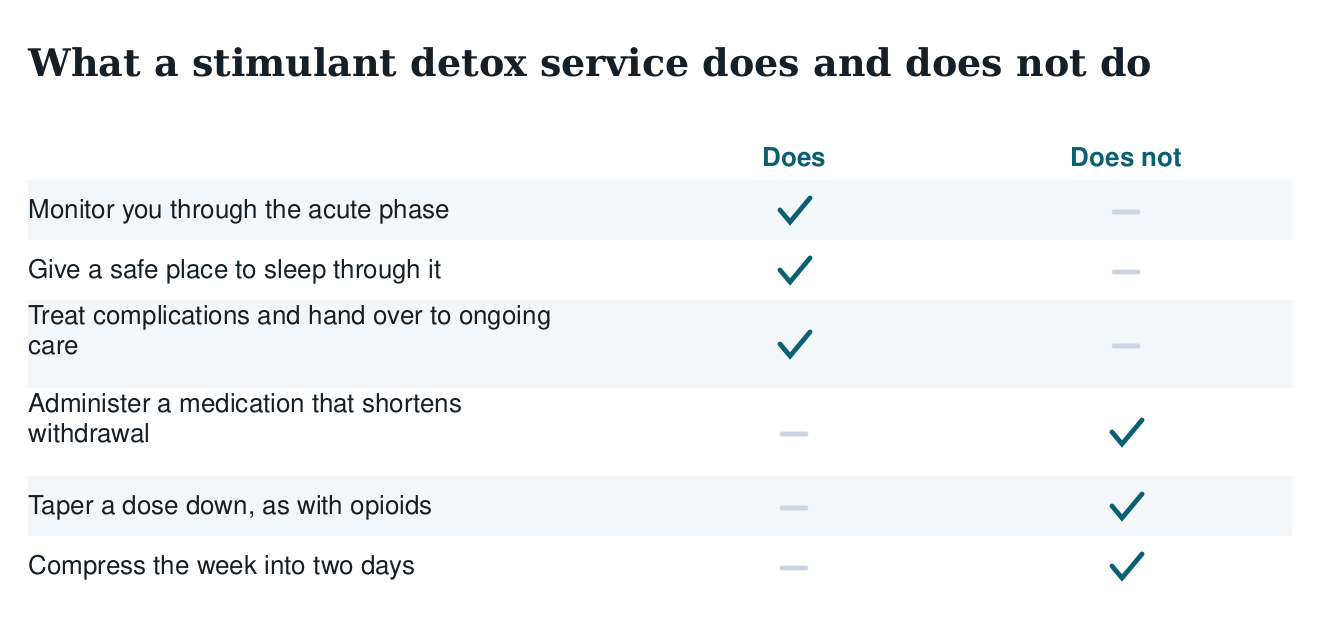
Detox is used loosely enough to be misleading, and searches for meth detox and crystal meth detox land on the same thing. In the federal directory it means a specific clinical service, medically supervised withdrawal management, and it is recorded separately for each substance; the fuller difference between it and a treatment programme is on our detox vs rehab page. For stimulants there is no medication to taper and no antidote to administer, so what a detox programme provides is monitoring, a safe place to sleep through the worst of it, treatment of complications, and a handover into ongoing treatment. That is worth something. It is not what the word implies to most people searching for it.
Detox drinks, kits and flush products
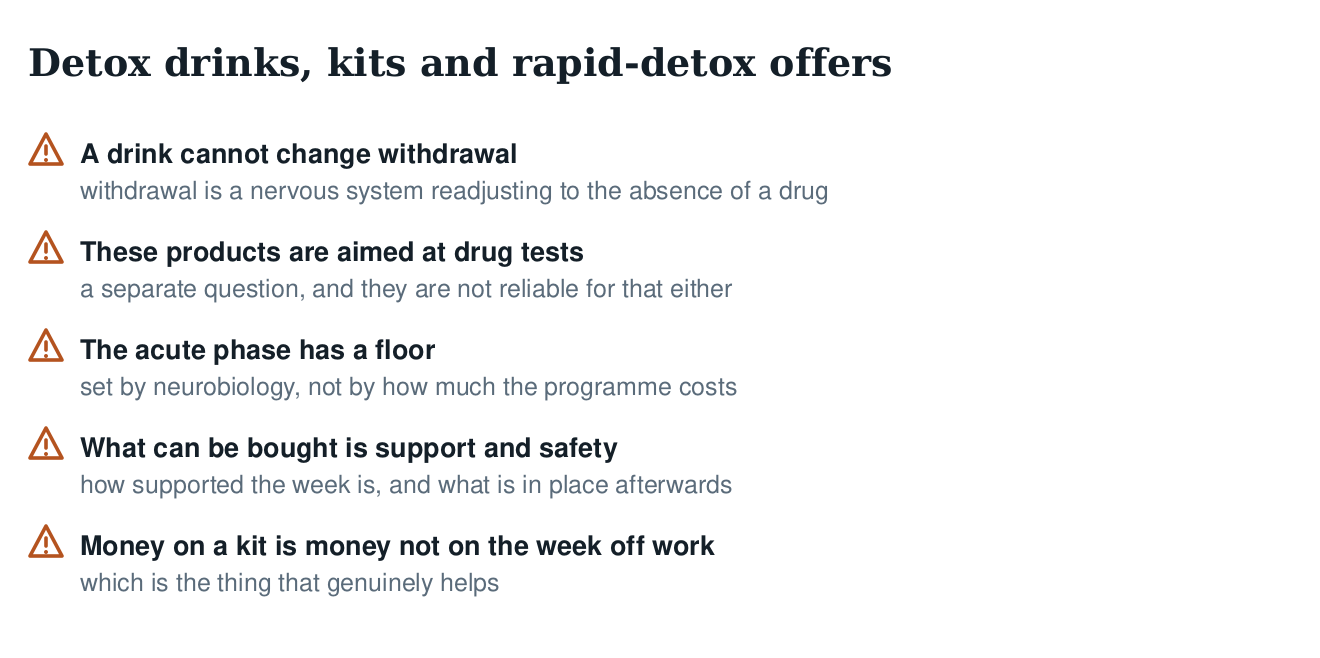
These are sold heavily against this search and they do nothing that matters here. Withdrawal is your nervous system adjusting to the absence of a drug it adapted to; no drink alters that process. The products are generally marketed at drug tests rather than at withdrawal, which is a separate question with its own separate answer, and they do not reliably work for that either. Money spent on a kit is money not spent on the week off work that would genuinely help.
Quick and rapid detox offers
The acute phase has a floor set by neurobiology, not by service quality. Nothing purchasable compresses a week of a nervous system readjusting into two days. What a good programme can change is how supported and how safe that week is, and whether anything is in place on the other side of it. Those are worth paying for; speed is not on the menu regardless of what is advertised.
Can it be done at home
Frequently it is, and for many people without complications that is what happens by default. The things that make it safer are unremarkable: somebody who knows what you are doing, permission to sleep as much as your body demands, food and fluids within reach, and a clear plan for what triggers a call for help. Doing it at home becomes the wrong choice when psychosis, severe depression, or alcohol or benzodiazepine dependence are in the picture.
Where stimulant detox is actually offered, counted
The directory records detoxification separately for each substance, which lets us answer a question nobody publishes: how many US facilities offer it for methamphetamine, and how that compares with the substances people assume are equivalent. We pulled the whole directory and counted. Methamphetamine detox turns out to be the least available of the five, essentially tied with cocaine and well behind opioids.
| Detoxification offered for | Share of facilities | Facilities |
|---|---|---|
| Opioids | 19.5% | 1,722 |
| Alcohol | 16.1% | 1,426 |
| Benzodiazepines | 14.9% | 1,315 |
| Methamphetamines | 14.0% | 1,235 |
| Cocaine | 13.9% | 1,231 |
Opioids
- Share of facilities
- 19.5%
- Facilities
- 1,722
Alcohol
- Share of facilities
- 16.1%
- Facilities
- 1,426
Benzodiazepines
- Share of facilities
- 14.9%
- Facilities
- 1,315
Methamphetamines
- Share of facilities
- 14.0%
- Facilities
- 1,235
Cocaine
- Share of facilities
- 13.9%
- Facilities
- 1,231
Why the stimulants sit at the bottom
Probably for the same reason this page keeps returning to: there is no medication to administer. A detox service for opioids or alcohol has a pharmacological job to do with an established protocol. For stimulants the job is supportive, and supportive care is harder to bill for and easier to leave to an outpatient programme. Whatever the cause, the practical consequence is that a smaller number of places treat stimulant withdrawal as a distinct service, and 1,235 facilities across the whole country is not many.
And it depends enormously on where you live
Across the 32 states with at least 80 facilities in our pull, the share offering methamphetamine detoxification runs from 4.0 per cent to 27.6 per cent, with a median state at 11.1 per cent. California reports the highest at 27.6 per cent of 881 facilities, followed by Ohio at 25.0 per cent and Louisiana at 24.7 per cent. At the other end sit Wisconsin at 4.0 per cent, Hawaii at 5.0 per cent and Iowa at 5.2 per cent. A near sevenfold difference between states is not a difference in how much methamphetamine is used; it is a difference in how the treatment system was built, and it decides whether this service exists within reach of you.
The setting matters as much as the service
In the same pull, 79.2 per cent of facilities offer regular outpatient treatment, 46.1 per cent intensive outpatient, 21.7 per cent residential or 24-hour care, and 16.0 per cent long-term residential. Since stimulant withdrawal is mostly a matter of getting through a week safely rather than receiving a drug, where you do it and who is around often matters more than which programme name is on the door; we compare the settings in inpatient vs outpatient.
What these numbers are not
Self-reported service categories rather than an audit. A facility ticking methamphetamine detoxification has told the directory it offers that, not demonstrated the quality of it. Use the figures for the shape of the landscape and the phone call for the specific place. Worth noting for comparison: our separate pull of treatment approaches, on a different day and a different denominator, found contingency management at 51.2 per cent against 52.9 per cent here, which is reassuring about reproducibility but not an invitation to mix the two denominators.
How this differs from cocaine withdrawal
Both are stimulants, both produce a withdrawal dominated by mood and craving rather than physical signs, and both lack an approved medication. The differences are in the timing and the texture. Cocaine has a short half-life and its crash is measured in days; methamphetamine stays in the body considerably longer and the acute phase is correspondingly stretched, with the sleeping and eating far more pronounced. Our own count found the two almost identically underserved for detox, 14.0 per cent against 13.9 per cent, which is the one place they behave the same.
Which page you want
If the substance is cocaine, our cocaine withdrawal timeline covers its own evidence and its own sources, including what the National Library of Medicine says about treatment setting. This page is about methamphetamine specifically, and the timelines are not interchangeable despite both drugs being stimulants.
What changes how hard it is
How long and how heavily the person used, by some distance. Route of use, because smoking and injecting produce a different pattern of exposure from swallowing. Whether other substances are involved, which is the single biggest modifier of the risk picture. Any psychiatric condition underneath, because the depressive phase lands on top of whatever was already there. And practical circumstances: somebody sleeping rough is having a different withdrawal from somebody who can sleep for two days in a quiet room, regardless of the pharmacology.
Getting through the week
These are the practical parts of quitting meth that nobody writes down. Let yourself sleep, since the body is asking for it and this is the one withdrawal where that instinct is useful. Eat when appetite returns, which it will, sharply. Keep fluids nearby. Arrange the week so that nothing important depends on your concentration, which will not be reliable. Tell one person what you are doing. And decide in advance what would make you call someone, particularly around mood, because the judgement about whether things are bad enough is exactly what the depressive phase impairs.
For clinicians and anyone reading their notes
Stimulant withdrawal appears in the diagnostic and coding systems in its own right, which is what searches for meth withdrawal ICD 10 are usually after. Coding is a matter for the treating clinician and the current code set rather than a web page, and we will not print a code that might be superseded. If you are searching for UpToDate on meth withdrawal treatment or symptoms, it is a paid clinician reference behind a subscription, which is why those searches rarely end well for someone without an institutional login. The freely available primary sources are the two this page is built on, the 2005 Addiction study and NIDA, and both are linked below.
What this page cannot tell you
It cannot tell you your own timeline, and the reason is not modesty. The evidence base for the numbers everyone publishes is one study of 21 people plus clinical experience, and the two most authoritative sources disagree about when the peak arrives. It cannot offer you a medication that reliably helps, because none is approved and the best trial found a response in about one person in seven. What it can do is show you where the familiar figures came from, what they rest on, and how few places in the country treat this as a service worth listing.
Where this sits in the system of care
Addiction treatment is organised into levels of care, and clinicians choose between them using the ASAM criteria (six dimensions covering withdrawal risk, medical and psychiatric conditions, readiness, relapse risk and, decisively, the environment you return to. Facilities are licensed by the state and many hold additional accreditation from bodies such as the Joint Commission or CARF; that status is worth confirming for any specific programme. Percentages below are our count of how many facilities in the federal directory report offering each level of care.
- Detox19.5% of facilitiesmedical withdrawal management, 3–7 daysDetox vs rehab
- Residential21.4% of facilitieslive on site, 24-hour staffingInpatient vs outpatient
- PHP20–30 structured hours a week, sleep at homePHP vs IOP
- IOP9–19 hours a week, usually compatible with workPHP vs IOP
- Standard outpatient85.4% of facilities1–8 hours a week, the maintenance levelMutual aid options
“Remaining in treatment for an adequate period of time is critical.”
Programmes for specific groups
Facilities also report dedicated programming, and the coverage is wider than most people expect, worth asking about before assuming a programme will not fit. From our count: 42.7% run programmes for adolescents, 39.2% for veterans, 38% for pregnant and postpartum women, and 25% provide services in Spanish. Medication for opioid use disorder is available at 59.2% (buprenorphine) and 13.7% (methadone).
Cost and coverage vary by level: residential care is the tier insurers scrutinise most and almost always requires prior authorisation before admission. See what your plan covers and how to pay without insurance. Family involvement is a standard part of most programmes, and aftercare planning ( step-down to a lower level, sober living, relapse prevention) should be discussed before admission, not at discharge. If a mental health condition is also present, ask specifically whether the programme is staffed for co-occurring disorders: 69.5% of facilities in the directory report treating them, but that is a self-reported field worth confirming.


Common questions
How long does meth withdrawal last?
The acute phase runs about seven to ten days according to the 2005 Addiction study that the figure comes from, with a subacute phase of at least two more weeks. NIDA describes symptoms peaking two to three days after last use and lasting about a week. After the acute phase, low mood, anxiety and cravings can persist for several months.
When does meth withdrawal peak?
The two main sources disagree, which is worth knowing. NIDA says two to three days after last use. The 2005 study found severity highest within 24 hours of last use and declining from there. The practical reading is that the worst arrives early rather than building slowly.
What are the symptoms of meth withdrawal?
NIDA lists depression, anxiety, irritability, pain and discomfort, sleep problems, cravings and trouble concentrating. The 2005 study described the acute phase as characterised by increased sleeping and increased eating alongside depression-related symptoms. It looks far less physical than people expect.
Can you die from meth withdrawal?
Stimulant withdrawal is not generally considered life-threatening in the way untreated alcohol or benzodiazepine withdrawal can be. The real dangers are severe depression during the acute and subacute phases, psychotic symptoms persisting from the period of use, and any other substance in the picture that does carry a dangerous withdrawal.
Is there a medication for meth withdrawal?
No. NIDA states there is no FDA-approved medication for methamphetamine use disorder or any stimulant use disorder. The best trial, ADAPT-2 in the New England Journal of Medicine in 2021, tested injectable naltrexone plus bupropion and found a 13.6 per cent response against 2.5 per cent on placebo over 12 weeks, which the authors themselves described as low.
What actually helps with methamphetamine use?
Contingency management, which NIDA names as the best-studied behavioural treatment and the one most associated with treatment success. It provides small tangible incentives for verified abstinence. In our count of the federal directory, 51.8 per cent of facilities report offering it.
How long does it take to detox from meth?
Detox in the clinical sense covers the acute phase, so roughly a week to ten days, and nothing purchasable shortens it. For stimulants there is no medication to taper, so what a detox service provides is monitoring, a safe place to sleep through it, and a handover into ongoing treatment.
Do detox drinks or kits work for meth?
No. Withdrawal is your nervous system readjusting to the absence of a drug, and no drink changes that. These products are generally marketed at drug tests rather than at withdrawal, which is a different question, and they are not reliable for that either.
Where can I detox from meth?
Fewer places than you would expect. In our count of 8,848 facilities in the federal directory, 14.0 per cent report methamphetamine detoxification, the lowest of the five substances tracked and below the 19.5 per cent that report opioid detox. Ask specifically rather than assuming a programme covers it.
Can you go through meth withdrawal at home?
Many people do, and for someone without complications that is often what happens. It becomes the wrong choice when there are psychotic symptoms, severe depression, or alcohol or benzodiazepine dependence alongside, since those carry risks the meth part does not.
Is meth withdrawal worse than cocaine withdrawal?
They are similar in kind and different in timing. Methamphetamine stays in the body longer, so the acute phase is more stretched and the sleeping and eating more pronounced; cocaine crashes faster. Our count found both almost equally underserved for detox, 14.0 per cent against 13.9 per cent.
Why do different websites give different meth withdrawal timelines?
Because the evidence base is thin. Most of the numbers trace to one 2005 study of 21 inpatients, and NIDA describes a slightly different peak. Pages that present an hour-by-hour schedule are more confident than the underlying research supports.
Sources
- McGregor C et al., "The nature, time course and severity of methamphetamine withdrawal", Addiction 2005;100(9):1320-9 (PubMed 16128721)
- NIDA: Methamphetamine, on withdrawal symptoms, timing and the absence of an approved medication
- Trivedi MH et al., "Bupropion and Naltrexone in Methamphetamine Use Disorder", N Engl J Med 2021;384:140-153 (ADAPT-2, PubMed 33497547)
- SAMHSA FindTreatment.gov, the public directory we counted
- MedlinePlus: Methamphetamine
Compare levels of care
Check what your plan covers
How this page was made
- Who wrote it:
- the Treatment Compass editorial team : researchers and writers, not clinicians. No doctor has reviewed this page, and we do not claim otherwise. What that means in practice: we report what public clinical sources say and show you where to read them, rather than offering a clinical opinion of our own.
- Checked against:
- 5 primary sources listed above: federal agency material and published clinical criteria. Where a figure varies by state, plan or facility, we say so instead of publishing a number that looks authoritative and is not.
- Original analysis:
- the facility proportions on this page are our own count of SAMHSA’s public directory. The full method is documented , including what we count, what we deliberately do not publish, and an error the approach caught. You can repeat the pull and check the numbers.
- Last reviewed:
- . This date changes when the content is actually re-checked, not automatically on every visit.
- What this page is not:
- a medical recommendation, a diagnosis, or a referral. Decisions about levels of care and medication belong with a clinician who knows your history. We do not operate facilities, take placement fees, or receive payment for sending anyone anywhere.
Related on this site
- Cocaine withdrawal timelinethe other stimulant: similar in kind, different in timing, with its own sources
- Opioid withdrawal timelinethe withdrawal people picture when they hear the word, and why this one looks nothing like it
- What happens in rehabwhat a programme actually consists of once the acute phase is behind you
- Relapse warning signsthe months of low mood and craving after the acute phase are when this matters
More guides
- How to Get Someone Into RehabYou usually cannot force an adult into addiction treatment. What works is removing the obstacles, picking the moment, and knowing the legal exceptions.
- Paying for Rehab Without InsuranceState-funded programmes, sliding-scale fees, federal block grants and payment plans. What each option actually is, who qualifies, and how to reach it.
- Rehab Rules: What You Can and Cannot Do in TreatmentWhat treatment facilities restrict and why: phones, visitors, relationships, leaving early. Rules vary by level of care, so here is what to ask first.
- Suboxone Withdrawal Timeline: Why It Starts Late and Lasts LongerWhy buprenorphine withdrawal is delayed, what the FDA label says about tapering, and our count of how many US facilities will actually help you come off.
- 7-OH Withdrawal Timeline: What It Is and Why Stopping Is HardWhat 7-hydroxymitragynine actually is, why withdrawal behaves like an opioid, and what the Federal Register says about the ban as of September 2026.
- Cocaine Withdrawal Timeline: What the Days Actually Look LikeThe crash, the weeks after, and why the withdrawal is not the dangerous part. With our own count of which treatments US facilities actually offer.
- Opioid Withdrawal Timeline: What Happens, and WhenSymptoms start around 12 hours after short-acting opioids and 30 after methadone. Fentanyl changes the picture, and the real danger comes after it ends.
- Relapse Warning Signs: What Comes Before Using AgainRelapse starts weeks before anyone picks anything up. The published model names three stages, and the early one has no thoughts of using in it at all.
- Rehab for Professionals: What Is Actually DifferentLicensed professionals get the best documented outcomes, and the most monitoring. What that trade involves, state by state.
- What Happens in Rehab: The Day, the Week, the MonthAdmission day is paperwork, not therapy. Most of the rest is group work. An honest account of the schedule, the therapies by name and the emotional arc.
- Court-Ordered Rehab: How It Works and What the Evidence ShowsA judge can order treatment by several routes, each with different consequences. Drug court, civil commitment and what each means.
- Sober Living Rules: What They Are and What Is EnforceableAbstinence, testing, curfew, chores and rent are near-universal. What is negotiable, what the law protects, how to spot a bad house.
- How Long Does Suboxone Stay in Your System?Buprenorphine has a 24 to 42 hour half-life. Urine tests find it for about a week, hair for months, and the blocking effect fades sooner than the drug does.
Weighing levels of care? See PHP vs IOP and what your insurance covers.
This page is information, not medical or legal advice. Laws on commitment and treatment differ by state. If you are in crisis, call or text 988 in the US, or reach the SAMHSA National Helpline at 1-800-662-4357 — free, confidential, 24/7.